Quick summary
Charting after clinic is the most common unpaid hour in aesthetic practice. It is why providers describe a good day as an expensive one. AI scribes address it by drafting the note from the conversation in the room. The important variable is not transcription quality, which is now good across the category, but whether the note lands in the chart as structured data or arrives as a block of text somebody has to move. This guide covers what an AI scribe actually does, why the integration decides the value, what HIPAA requires, and the specific things to test before you buy one.
What an AI scribe actually does
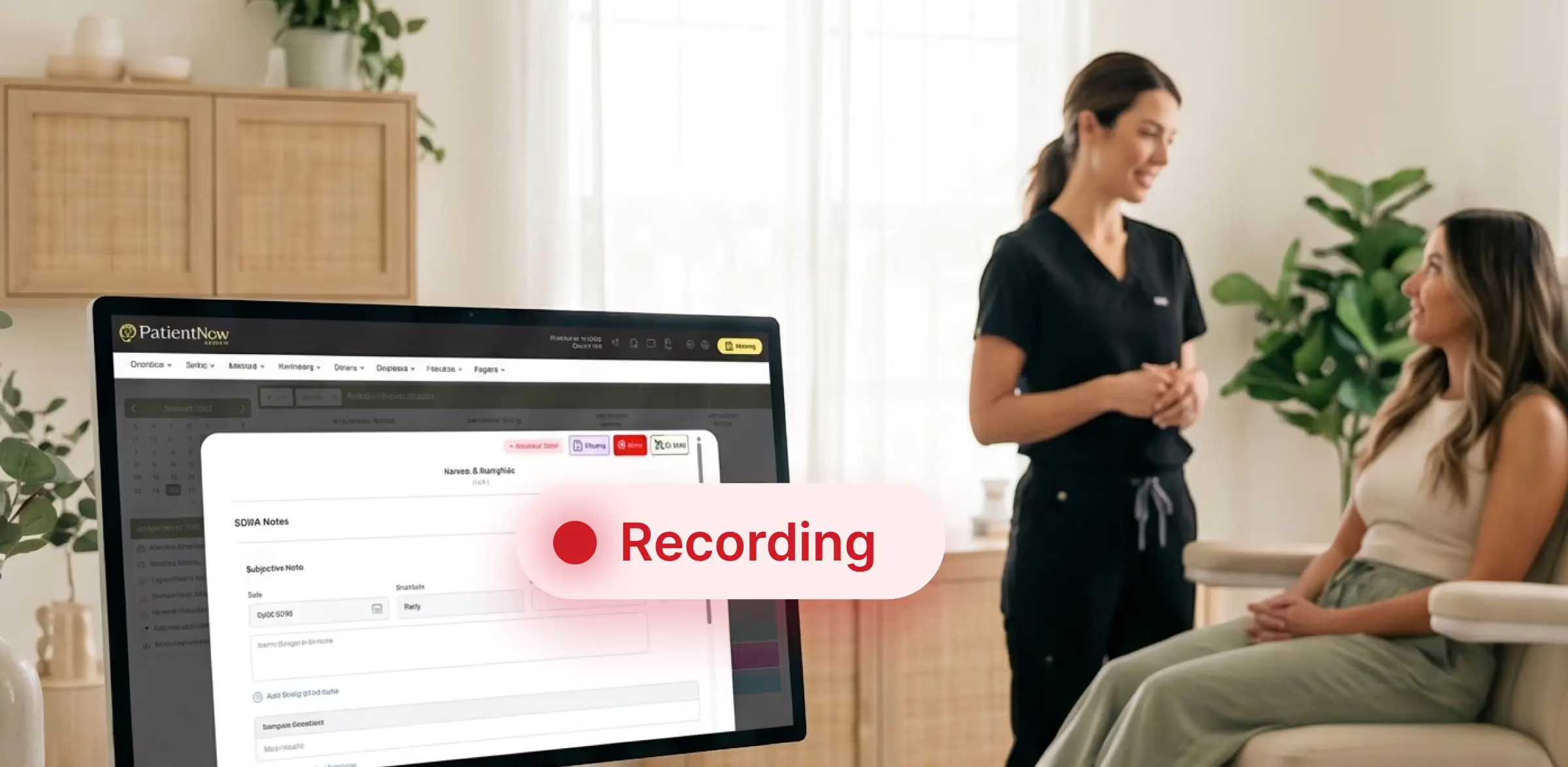
It listens to the clinical encounter, with consent, and drafts the note.
The mechanics are straightforward. The provider starts a session, has the normal consultation, and the system produces a structured draft afterward: history, assessment, what was done, what was discussed, what happens next. The provider reviews it, corrects anything wrong, and signs. The output is a draft for a clinician to approve, never a finished record.
Two things it is not. It is not dictation, which requires you to speak the note aloud in note form; a scribe works from a natural conversation with a patient. And it is not documentation without review. The provider remains responsible for the accuracy of the record, and every serious product is built around that review step rather than trying to remove it.
In aesthetics specifically, the note has demands a general medical scribe often handles poorly: injection sites and volumes, product and lot numbers, device settings, treatment areas, and the consent discussion. A scribe that produces an excellent general clinical note and cannot capture units by site is not solving the problem in this specialty.
Why the integration matters more than the transcription
Transcription accuracy is largely a solved problem. Where products differ enormously is what happens to the note afterward.
A standalone scribe produces text. Somebody then copies it into the chart, or it arrives as an attachment, or it syncs as a block into a notes field. The provider still opens the EMR, still navigates to the encounter, and still enters the structured items separately, because a block of text is not a set of fields. The time saved is real and it is a fraction of what was advertised, because the second half of the work was never the typing.
A scribe built into the EMR writes into the record itself. The note attaches to the correct encounter for the correct patient without anyone selecting anything. Structured fields populate as fields: treatment areas, products, units, lot numbers. It has access to the chart, so it knows what was done last time and can reference it. And the data stays reportable, which is the part practices notice a year later, because a note pasted as text cannot be queried and structured data can.
That last point deserves weight. If the injection detail lives in prose, you cannot answer how much of a product you used last quarter, which providers use more per area, or which patients are due for a retreatment. If it lives in fields, those are filters. A scribe that saves ten minutes and destroys your reporting is a poor trade.
The practical test in a demo is to stop watching the transcript and watch where the output goes. Ask to see the note land in the chart, and ask which parts arrived as structured data rather than text.
Can AI tools in healthcare be HIPAA compliant?
Yes, and compliance is a property of the vendor and the configuration rather than of the technology. Six things need to be true.
A signed Business Associate Agreement. The vendor is processing PHI on your behalf. No BAA, no deployment, regardless of how good the product is.
Encryption in transit and at rest, covering the audio as well as the resulting note. Audio is often overlooked and it is the most sensitive artifact in the chain.
Individual accounts and role-based access, so who can see which encounters is controlled and knowable.
Audit logging of who accessed, edited, and signed what.
A clear retention answer for the audio. Ask specifically how long recordings are kept, whether they can be deleted immediately after the note is generated, and whether that is configurable. Many practices want the audio gone the moment the note is signed, and a vendor should be able to do that.
An explicit answer on model training. Ask in writing whether your patient data is used to train models, whether that is on by default, and how to opt out. This is the question most likely to produce a vague answer, and a vague answer here is a no.
Patient consent is the other half. Recording a clinical encounter requires the patient's agreement, and several states require all-party consent for recording generally. The workable pattern is a clear explanation, consent captured in the intake paperwork, a verbal confirmation at the start, and a documented, friction-free way to decline. Patients decline far less often than practices expect when the reason is explained plainly, and the ones who do decline need a path that does not feel like an obstacle.
What good looks like in aesthetics
Beyond the general requirements, a few things separate a scribe that works in an aesthetic practice from one that works in primary care.
It captures the detail that matters here: product, units, injection sites, device settings, treatment areas, and lot numbers, as structured data rather than prose. It handles the consultation as well as the treatment, since a large share of aesthetic encounters are discussions about candidacy, expectations, and planning, and those notes carry real medicolegal weight. It documents the consent conversation, which is frequently the most important paragraph in an aesthetic record. It works across the full treatment arc, referencing what was done previously so a follow-up note is not written from scratch. And it handles the room as it actually is, with two people talking, interruptions, and a patient who changes their mind mid-conversation.
One more, easy to overlook: it should be fast to correct. A provider reviewing a draft wants to fix three things and sign, not re-navigate the whole note. Editing speed is what decides whether the tool gets used on a busy Friday.
What to test before you buy
Six tests, and they take one demo.
Watch a note land in the chart. Not a transcript on a screen. The note, in the record, on the right encounter, with fields populated.
Ask which fields are structured. Then ask whether you can report on them afterward.
Bring a realistic encounter. Multiple areas, a product change mid-treatment, a patient question about something unrelated. A clean scripted demo tells you nothing about a real Tuesday.
Ask what it does when it is unsure. A good system flags uncertainty for review rather than confidently producing a wrong number. Ask to see a flagged draft.
Ask about the audio. Retention, deletion, and whether it is used for training. Get it in writing.
Time the review step. The claim is time saved. Measure the review and correction time on a real note, because that is the number that determines whether the saving is real.
Then ask the question that matters most operationally: what happens on the day the internet is slow or the system is down. A documentation workflow with no fallback is a documentation workflow that will fail at some point during clinic.
What it does not fix
Worth being straight about, because overstated expectations are why some practices abandon these tools.
It does not remove the provider's responsibility for the record. Every note needs review, and a provider who signs without reading has created a new risk rather than removed an old one. It does not fix a badly designed chart: if your templates ask for things nobody uses, a scribe fills them in faster. It does not solve documentation backlog on its own, because a week of unsigned notes still needs a week of review. And it does not replace clinical judgment about what belongs in the record.
What it removes is the transcription and structuring work, which is most of the after-clinic hour. The clinical thinking stays with the clinician, where it belongs.
How PatientNow approaches this
PatientNow's AI Scribe is built into the EMR rather than bolted alongside it, which is the distinction this guide is mostly about.
The note is drafted from the encounter as a structured SOAP note and saved to the patient's chart on the correct visit, in the same record that holds the treatment history, injectable records, photos, forms, and consents, so it is never a block of text somebody has to move. The provider reviews, edits, and signs, always. And it runs inside the same HIPAA-compliant environment as the rest of the platform, under one agreement, rather than adding a separate vendor with separate access to your patient data.
If you are evaluating scribes, run the test above on all of them. Watch where the note goes.
Related reading
- Why clinical documentation matters in aesthetics
- The complete guide to med spa HIPAA compliance
- PatientNow's Business Associate Agreement
Frequently asked questions
How much time does an AI scribe actually save?
It depends far more on the integration than the transcription. A standalone tool that produces text somebody moves into the chart saves the typing and leaves the structuring, which is often the larger half. An integrated one that populates fields directly removes both. The number to measure in a trial is review-and-sign time on a real note, not the vendor's figure.
Do patients have to consent to being recorded?
Yes. Recording a clinical encounter needs the patient's agreement, and some states require all-party consent for recording generally. Handle it with an explanation in the intake paperwork, a brief verbal confirmation before starting, and an easy way to decline. Explained plainly, most patients are comfortable, and the practices that struggle are usually the ones that were not upfront.
Is the audio kept, and who can hear it?
Ask, and get the answer in writing. Retention varies widely, some vendors delete audio once the note is generated and others keep it for extended periods. You should also ask who at the vendor can access recordings and whether audio or notes are used to train models. Vague answers to any of these are a reason to stop.
What if the scribe gets something wrong?
The provider is responsible for the record, which is why review before signing is not optional. A well-built system helps by flagging low-confidence items rather than presenting everything with equal certainty. Ask to see how uncertainty is surfaced, and treat a system that never flags anything as a warning sign rather than a strong one.
Does it work for consultations as well as treatments?
It should, and in aesthetics this matters more than in most specialties, because so much of the encounter is discussion about candidacy, expectations, and planning. Those notes carry significant medicolegal weight. Test a consultation-only encounter in the demo, since some tools are noticeably weaker there than on a procedural note.
Can it replace our medical assistant?
No, and a vendor selling it that way is overselling. It replaces the documentation task, not the person, and the clinical support, room turnover, and patient interaction that a medical assistant provides are not part of what it does. What practices usually report is that the same team spends less time typing.
Bring a messy, realistic encounter to the demo, and watch where the note ends up.
This guide is general information about how HIPAA and state recording laws apply to clinical documentation. It is not legal advice, and requirements vary by state.
Explore this post
Book a demo to see PatientNow in action