Quick summary
Salon and booking platforms are built for beauty, not for medicine. They handle scheduling, payments, and client records well, because that is what they were built to do. The moment a practice adds injectables, prescription products, or anything requiring medical oversight, the requirement changes from a client record to a medical record, and that is a different category of software with different legal obligations behind it. This guide covers what actually separates the two categories, the five obligations that attach the day you add a medical treatment, how to tell which side your practice is already on, and why waiting is sometimes the right call.
What salon platforms do well
Worth saying first, because these tools are not the problem.
Booking and salon platforms are strong at the operational core of a service business: online booking that clients actually use, calendar and resource management, point of sale, memberships and packages, retail inventory, automated reminders, and client communication. Many have better booking experiences and cleaner interfaces than clinical systems do, because that is where their product investment has gone for years.
For a spa doing facials, waxing, massage, lashes, and retail, that is the whole requirement. Adding a clinical system to that practice would add cost and complexity for no benefit. The question in this guide only becomes live when the service menu changes.
What actually separates the two
Two questions decide it. Is a licensed clinician making a clinical decision, and must a medical record exist? How medical the treatment sounds has no bearing on either.
You are on the salon side when services are cosmetic and non-invasive, no prescription products are involved, no medical oversight is required, and there is no medical record obligation. Facials, waxing, lashes, brows, massage, most peels, and basic skincare sit here.
You are on the medical side when any of the following are true: a prescription product is administered, the treatment requires a medical director or physician oversight, a licensed clinician performs an assessment and makes a treatment decision, the treatment carries risks requiring informed consent and adverse event documentation, or state law requires a medical record for the service. Injectables, prescription weight loss treatment, many laser and energy devices, medical-grade peels, PRP, IV therapy, and prescription skincare programs sit here.
Most of the confusion sits in the middle ground. Check locally rather than assume. Some laser and energy treatments are classed as medical in some states and not others. Microneedling depth changes its classification in several jurisdictions. Supervision requirements for esthetician-performed treatments vary substantially. Your state board and your medical director are the authorities on which side a specific service sits, and the answer genuinely differs by state.
What changes the day you add a medical treatment
A client record becomes a medical record. This is the substantive change and it carries obligations the previous system was never designed for: retention for a period set by state law, amendment rights, patient access rights, controlled disclosure, and audit logging of who accessed what. A notes field in a booking app is not a medical record, and adding more text to it does not make it one.
Documentation becomes clinical. Assessment, treatment plan, informed consent, exactly what was administered, where, how much, from which lot, adverse events, and follow-up. Injection mapping and product lot tracking are the two most likely to be missing, and lot tracking is the one that matters in a recall.
Compliance scope expands. HIPAA applies in ways it may not have before, which means a Business Associate Agreement with your software vendor, access controls, audit logging, and a breach response process. Ask your current vendor whether they will sign a BAA. Some will not, and that answer settles the question on its own.
Consent becomes substantive. Informed consent for a medical treatment is a documented discussion of risks, alternatives, and expected outcomes, tied to the specific treatment and retained with the record. A checkbox on a booking form is not that.
Clinical oversight has to be visible. Where a medical director or supervising physician is required, the system needs to show that supervision happened: who assessed, who authorized, who performed, and who reviewed. If your software cannot represent that chain, you cannot evidence it.
These obligations attach the day you start providing the service, not the day you get around to the software. A practice injecting for six months on a booking app has six months of records that may not meet the standard, and that gap does not close retroactively.
How to tell which side you are already on
Five questions. Any yes is a signal.
Are you keeping clinical information somewhere other than your main system, in paper consent forms, a separate consent app, a spreadsheet of lot numbers, or photos on a phone? Fragmentation is the most reliable early indicator, because it is what people do when the system cannot hold something.
If a patient requested their complete record tomorrow, could you produce it from one place? If it means assembling from three sources, you do not have a medical record.
Could you identify every patient who received a specific product lot, in minutes? This is the recall question, the one that turns an inconvenience into a serious problem.
Can you show, from the system, that required oversight occurred for a given treatment?
Does your vendor sign a BAA?
A practice that answers badly on even one of these is not deciding whether to cross over. It crossed the day the service went on the menu, and has been running on the old system out of momentum ever since.
The honest case for waiting
Switching is disruptive. It should not be automatic, and two situations genuinely argue for staying put.
You are testing the service. If you have added one medical treatment, are doing a handful a week, and are not certain it will become a real part of the business, the right move is often to keep the current system, document the clinical side rigorously on paper or in a dedicated compliant tool, and reassess at a defined point. The compliance obligations still apply in full and have to be met somewhere. What you are deferring is the platform decision, not the requirement.
Medical is a small and stable share. A spa where injectables are one afternoon a week may reasonably run a compliant clinical tool alongside the salon platform rather than moving the whole business. Two systems is a real cost in double entry and split reporting. At that ratio it can still be the right answer.
What does not work is running medical treatments through a salon platform and hoping the notes field is enough. That is an unfunded liability rather than a saving, and the cost arrives in a records request, a board complaint, or a recall.
What changes when you do move
Practices consistently underestimate three things.
Data migration is partial. Client details, contact information, and appointment history usually move. Clinical detail, consent records, and photos usually need manual work, because the source system stored them as free text or not at all. Ask any prospective vendor exactly what transfers, by field, and what does not. Get it specific, because "we handle migration" covers a wide range of outcomes.
The team needs real training, and clinical documentation is a genuine change in habit rather than a new interface. Budget more time than the vendor suggests, and expect the first weeks to be slower.
Booking may get worse before it gets better. Clinical systems have historically been weaker at the front-of-house experience that salon platforms perfected. Evaluate the booking flow as carefully as the charting, because a system your patients find harder to book with costs you revenue in a way the charting improvement has to outweigh. This gap has narrowed considerably, but it has not closed everywhere, so check rather than assume.
How PatientNow approaches this
PatientNow is a practice management platform built for aesthetic and elective practices, which means it is designed for exactly the practice this guide describes: one running both cosmetic services and medical treatments in the same business.
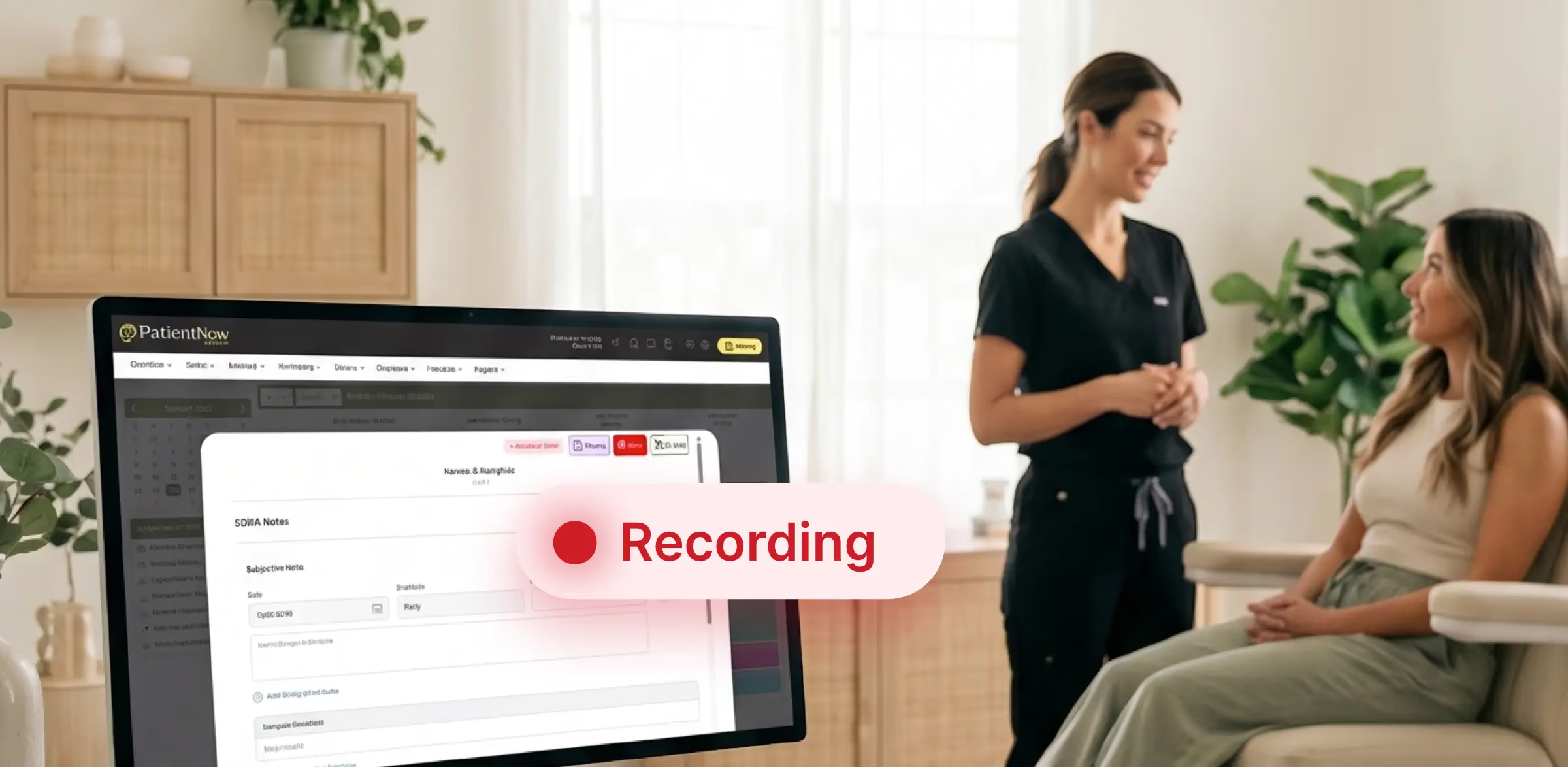
The medical record, consent, injection and lot documentation, and the audit trail all live in the same system as scheduling, point of sale, packages, and patient communication, so the clinical side does not become a separate tool with separate data. It is built for the aesthetic service mix rather than adapted from general medical software, and it operates under a Business Associate Agreement.
If you are somewhere in the middle of this, start with the five questions above. They will tell you whether this is a decision for now or for later. What you should not do is let a records request answer it for you.
Related reading
- Med spa software built for medical treatments
- Does your med spa really need EMR software?
- What is an EMR, and what does it have to do?
Frequently asked questions
Can I run a med spa on Square?
Square handles payments, booking, and retail well and was built for those jobs rather than for a medical record. If your services are entirely cosmetic and non-medical, it can be sufficient. Once you add injectables or anything requiring medical oversight, you need a medical record, clinical consent, and lot tracking, and those are outside what it was designed to provide. Square does publish a HIPAA Business Associate Agreement that applies when a covered entity uses its services with PHI, so the payments side can stay compliant; the medical record still cannot live in a booking app. Many practices keep it for payments and add a clinical system alongside.
Do estheticians need an EMR?
It depends on scope of practice rather than job title. An esthetician doing facials, waxing, and non-medical skincare does not need one. An esthetician working under medical supervision performing treatments classed as medical in your state does, because the record is a medical record regardless of who performs the service. Your state board defines which treatments fall where, and it varies.
We only do a few injectable appointments a week. Is that enough to switch?
Not necessarily to switch, but definitely enough to be compliant. The obligations attach to the service, not to its volume, so those appointments need proper medical records, consent, and lot tracking from the first one. Some practices meet that with a dedicated clinical tool alongside their existing platform until medical becomes a larger share.
What happens if we keep using salon software for medical treatments?
The risk is mostly invisible until something specific happens: a records request you cannot fully satisfy, a board complaint where documentation is the evidence, a product recall where you cannot identify affected patients, or a HIPAA question where your vendor never signed a BAA. Day to day nothing appears wrong, which is exactly why practices stay on it longer than they should.
Can we run both systems?
Yes, and plenty of practices do during a transition or permanently at a low medical ratio. The costs are double entry, split reporting, and the risk that clinical detail ends up in the wrong system. Make it a deliberate arrangement with a clear rule about what lives where, rather than something that happens by drift.
This guide is general information about how medical record and HIPAA obligations apply to aesthetic practices. It is not legal advice. Requirements vary by state, and your state board and medical director are the authorities for your practice.
Explore this post
Book a demo to see PatientNow in action