Quick summary
Many wellness and aesthetic practices struggle with disconnected systems, limited clinical tools, and inefficient workflows that slow growth. The right management platform brings scheduling, patient records, compliance, marketing, payments, and automation together in one place, helping practices improve efficiency, strengthen patient relationships, and scale with confidence. Here are the top 3 wellness center management platforms:
| Rank | Platform | Key strength |
|---|---|---|
| 1 | PatientNow | Designed for wellness practices needing clinical-grade EMR and marketing in one system |
| 2 | Pabau | Per-user alternative with strong clinical documentation |
| 3 | Zenoti | Well suited to large, multi-location wellness center chains with larger operational budgets |
What to look for in wellness center management software
"Wellness center management software" includes everything from fitness and spa scheduling tools to clinical platforms for med spas and aesthetic practices. The main difference is whether a business needs medical capabilities like HIPAA-compliant charting, injection tracking, and e-prescribing.
Choosing the wrong type of platform is a common mistake, with many practices eventually outgrowing basic schedulers and needing to migrate patient data. This guide reviews eight platforms across the spectrum. If CRM is the capability you are weighing, see our separate guide to CRM software for wellness centers. It focuses on what matters most for medical practices: compliance, clinical depth, patient retention tools, and whether marketing features support long-term growth.
Why listen to us
At PatientNow, our focus is helping wellness clinics, med spas, and plastic surgery practices reduce complexity. We aim to improve patient retention and grow with tools designed specifically for the aesthetics industry. This evaluation goes beyond marketing claims and star ratings.
It is based on public pricing, product documentation, and verified user feedback, with a focus on real-world practice outcomes and long-term usability. We prioritize verifiable capability and the features that matter most to aesthetics and medical wellness practices.
What is wellness center management software
Wellness center management software helps spas, med spas, clinics, and fitness studios manage bookings, scheduling, payments, client records, and marketing on a single platform. Clinical businesses also need HIPAA-compliant EMR features like SOAP notes, digital consent forms, e-prescribing, injection mapping, and before-and-after photos. These platforms fall into two categories:
- Clinical-grade: Built around a true EMR for regulated treatments.
- Salon-style: Focused on scheduling and retail, with limited or add-on clinical features.
Choosing the right category for your business is more important than choosing the platform with the best marketing.
What are the benefits of wellness center management software
The right wellness center management software helps businesses improve efficiency and client experiences while supporting long-term growth. It has a measurable impact on how wellness and aesthetic businesses operate. Here’s how:
- Reduce No-Shows: Automated SMS/email reminders, plus AI rebooking and waitlists on advanced platforms.
- Centralize Records: Store all patient/client information securely in one place rather than in paper files or spreadsheets.
- Increase Revenue: Integrated payments, memberships, and upsell prompts speed up checkout and boost sales.
- Support Compliance: HIPAA-compliant charting, audit logs, and digital consent forms for clinical practices.
- Automate Marketing: Drip campaigns, review requests, and lead follow-ups run with minimal manual effort.
- Track Performance: KPI dashboards, provider analytics, and inventory reports provide clear business insights.
Feature comparison chart
Before comparing individual platforms, it helps to see how they differ across the features that matter most for wellness and aesthetic practices. Use the following comparison as a quick reference before exploring the detailed reviews that follow:
| Software | Key strength | Starting price | Clinical features (injectables, eRx) | Free trial / demo |
|---|---|---|---|---|
| PatientNow | All-in-one wellness center platform: EMR + marketing + business tools | Custom pricing | Purpose-built | Demo only |
| Zenoti | Enterprise multi-location operations with AI workforce tools | Custom pricing | Med spa tier available | Demo only |
| Mindbody | Consumer marketplace exposure for fitness and wellness studios | $79/ |
Requires bolt-on clinical system | Demo only |
| Vagaro | Low-cost, broad-based booking for solo providers and small teams | From $23.99/ |
Native EMR, included in base plan | 30-day trial |
| Boulevard | Premium client experience and smart scheduling | Salons and spas from $195/ |
Charting and forms on med spa bundles; ePrescribe available as a paid add-on | Demo only |
| Pabau | Clinical documentation priced per user | Quoted after a demo; priced by team size (Solo: 1 user, unlimited patients) | Purpose-built | Demo only |
| AestheticsPro | Straightforward, purpose-built med spa EMR | $160/ |
Purpose-built | Demo only |
| WellnessLiving | Class scheduling and loyalty tools for fitness/ |
Starting at $69/ |
Not clinical | Demo only |
Reviewing the 8 best wellness center management software
Choosing the right wellness center management software depends on the type of practice you operate and the features you need most. Each review shares the core features, strengths, limitations, pricing, and trial options to help you compare solutions based on clinical needs, business goals, and long-term scalability:
1. PatientNow

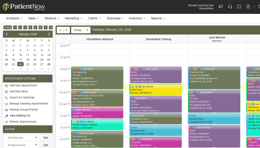
PatientNow is a leading platform for med spas, plastic surgery, dermatology, and wellness clinics. It combines a strong clinical EMR with scheduling, marketing, and practice management, removing the need for multiple systems.
Unlike many competitors that prioritize either clinical tools or business features, PatientNow delivers both. It offers specialized capabilities such as injection tracking and weight-loss progress monitoring built directly into the patient record.
Key features:
- Clinical EMR: HIPAA-compliant EMR with injection tracking, weight-loss monitoring, e-prescribing, telehealth, and lab integration with 120+ vendors.
- Built-In Marketing CRM: Lead capture, automated SMS and email drip campaigns, reputation management, social media posting with Canva integration, and AI content creation for social and email.
- Before-and-After Photos: RxPhoto enables standardized photo capture, image markup, and consultation/gallery management.
- AI Automation: Recura responds to every call, text and form, books appointments, and follows up to keep schedules full with less front-desk effort.
- Practice Management: KPI dashboards, employee goal tracking, inventory automation with purchase reorders, and audit logs.
- Payments & Finance: Integrated payments, memberships, patient financing, next-day funding, and QuickBooks synchronization.
Pros:
- Built specifically for aesthetics practices, with clinical workflows designed for medical use rather than adapted from a general EMR or salon scheduler.
- Includes built-in marketing tools that many competitors lack or charge extra for.
- Supported by 20+ years serving aesthetic practices.
- Combines EMR, CRM, scheduling, payments, marketing, and operations in one platform, reducing the need for multiple disconnected tools.
- Offers clinical-grade features including HIPAA-compliant charting, treatment documentation, e-prescribing, labs, telehealth, and before-and-after photo management through RxPhoto.
- Uses AI automation through Recura to help capture leads, follow up with patients, answer inquiries, and automate booking workflows.
- Provides business intelligence tools with KPI dashboards, inventory tracking, provider performance reporting, audit logs, and QuickBooks integration.
- Designed for both single-location clinics and growing practices that need scalable tools for multiple providers and locations.
Cons:
- The feature-rich interface has a learning curve, making onboarding time an important consideration.
- Some users report occasional UI friction.
- Pricing is not published; every plan is quoted after a demo.
Pricing:
- Pricing tailored to your practice. You get a custom quote.
Free trial details:
PatientNow does not publish a self-serve free trial. You’ll request a live demo, and pricing is typically scoped to your practice size and module needs.
2. Zenoti

Zenoti is an enterprise-grade platform for salons, spas, and med spas, supporting 30,000+ businesses worldwide. It offers multi-location management, centralized reporting, and AI automation, making it well suited to larger businesses. However, its custom pricing and enterprise scope can be less practical for single-location or small med spas.
Key features:
- Multi-Location Management: Centralized booking, inventory, payroll, and reporting across multiple locations.
- AI Automation: AI Workforce and AI Plus handle guest calls, lead scoring, and revenue-leak monitoring.
- Mobile POS: Enables chairside checkout with integrated tip and commission tracking.
- Advanced Reporting: Role-based dashboards for financial, operational, and marketing performance.
Pros:
- A key strength is multi-location analytics with a unified dashboard for chains and franchise groups.
- AI-powered automation for guest communication across calls, SMS, and web channels.
- Proven scalability with 30,000+ businesses worldwide.
Cons:
- Pricing is custom and undisclosed, which can make budgeting less transparent.
- AI Workforce agents are quoted separately from the core Zenoti OS platform, and multi-location pricing is customized, so total cost is hard to estimate before a sales call.
- Can be excessive and costly for single-location practices.
Pricing:
Custom quote only.
Free trial details:
No self-serve trial. Zenoti requires a demo call and custom quote before signup.
3. Mindbody
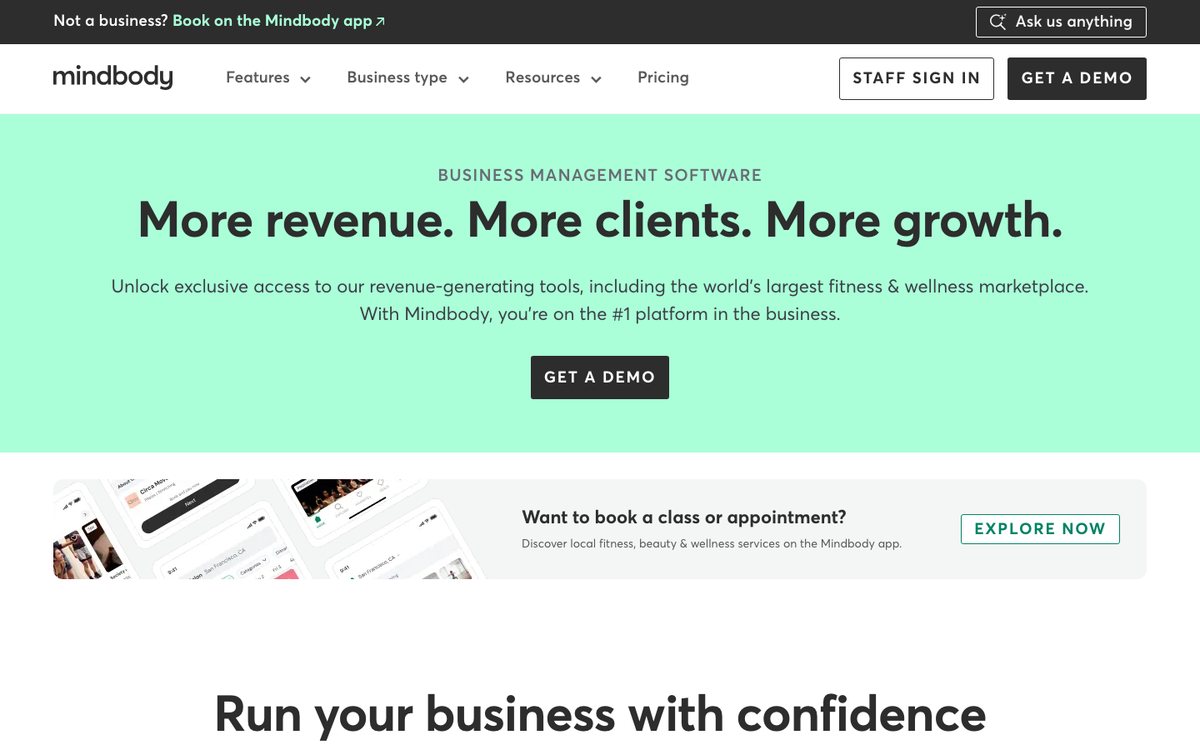
Mindbody is a well-known wellness platform with a consumer marketplace that helps fitness studios attract new clients and book classes. It is a major advantage for class-based practices, but it requires a separate EMR, which increases costs and leads to duplicate data entry for clinical providers.
Key features:
- Consumer Marketplace: Listing in the Mindbody app, exposing businesses to millions of potential clients.
- Online Booking: Branded booking widgets that integrate directly with a business’s website.
- Scalable Plans: Tiered plans (Starter, Accelerate, and Ultimate) that grow with the business.
- Integrated POS: Combines retail and service checkout into a single transaction.
Pros:
- Provides the widest marketplace exposure of the platforms reviewed for studios that depend on walk-in and first-time bookings.
- Mature platform with extensive integrations, including ClassPass.
- Flexible tiered plans allow fitness-focused businesses to add features as they grow.
Cons:
- Offers SOAP notes, but has no injection mapping, e-prescribing or aesthetics-specific EMR built in; those route through third-party integrations, so clinical practices end up running a second system.
- Marketplace bookings carry commission and payment processing fees on top of the subscription. Confirm current rates with Mindbody.
- Billing is per location, and Mindbody's own pricing page says the subscription rises with each location added, which multi-site businesses should model before signing.
Pricing:
- Starter: Custom quote. Price starting at $79/month/per location.
- Accelerate: Custom quote.
- Ultimate: Custom quote.
Free trial details:
No published free trial. Mindbody requires a sales consultation to obtain pricing for the Accelerate and Ultimate tiers.
4. Vagaro

Vagaro is an affordable business management platform for salons, spas, and small medical aesthetics practices. Its standout feature is a HIPAA-compliant EMR included in the base subscription rather than offered as a separate add-on. This makes it well suited to solo injectors and small practices.
Key features:
- Clinical Tools: Includes SOAP notes, digital intake and consent forms, photo documentation, and e-prescribing without a separate EMR fee.
- Flexible Pricing: Per-calendar pricing allows solo providers to start affordably and scale as staff is added.
- Business Management: Built-in payroll, inventory management, and automated email/SMS marketing.
- Marketplace Exposure: Offers client marketplace visibility similar to Mindbody’s at a lower cost.
Pros:
- Affordable entry point for solo practitioners and small teams.
- HIPAA-compliant charting is included in the base platform rather than a premium tier.
- Combines booking, POS, payroll, and marketing without requiring multiple subscriptions.
Cons:
- Clinical documentation is more limited than aesthetics-focused platforms, with no dedicated injection-mapping or weight-loss module.
- Per-calendar pricing can become harder to manage as providers and treatment rooms are added.
- Reviewers report limitations in advanced multi-location reporting.
Pricing:
From $23.99/month promotional against a $30 list price for a solo provider (Just Me plan) in the US, scaling to $83.99/month for 7 or more team members. Multi-location pricing is custom.
Free trial details:
Vagaro offers a free trial for its One Location plan, allowing practices to test the platform before subscribing.
5. Boulevard

Boulevard is a design-focused platform for salons, spas, and med spas that emphasizes a premium client experience with advanced scheduling and client profiles. Its Aesthetics Bundle supports med spas, but charting, forms and ePrescribe are paid add-ons or sit on the med spa bundles rather than in the core plans, so a clinical practice should price the bundle, not the Essentials tier.
Key features:
- AI Scheduling: Smart scheduling with AI-powered gap optimization to automatically fill unused appointment slots.
- Client Profiles: Detailed client records with notes, photo galleries, and spending analytics beyond a standard CRM.
- Communication & Payments: Built-in two-way SMS messaging and integrated payment processing.
- Aesthetics Bundle: A dedicated package designed specifically for med spas.
Pros:
- Delivers one of the most advanced client-facing scheduling experiences for high-value, appointment-based businesses.
- Strong multi-location management for larger salon and spa groups.
- Consistently praised for its modern design and ease of use by front-desk staff.
Cons:
- Consent and intake forms are less customizable than dedicated medical solutions, and the deeper clinical tooling sits on the higher-priced med spa bundles.
- Does not list payroll among its features.
- Premium per-location pricing can become expensive for multi-site businesses, and there is no self-serve trial.
Pricing:
- Essentials (salons and spas): $156/month promotional, $195 standard.
- Premier (salons and spas): $260/month promotional, $325 standard.
- Prestige (salons and spas): $364/month promotional, $455 standard.
- Aesthetics Starter Bundle (med spas): $364/month promotional, $455 standard.
- Aesthetics Bundle (med spas): $416/month promotional, $520 standard.
All pricing is per location for the US, billed monthly; annual billing reduces the monthly rate by about 10%. Promotional rates are for new customers only. Rates checked September 2026.
Free trial details:
No self-serve free trial. Boulevard requires a live demo call with sales before signup. For a wider set of options, see our guide to Boulevard alternatives for med spas.
6. Pabau

Pabau is a fast-growing practice management platform built for aesthetic, wellness, and private medical clinics, offering a true clinical EMR priced per user rather than per feature. It is a strong fit for practices that need robust clinical documentation without paying for modules they do not use. Pabau is well suited to newer clinics and small teams.
Key features:
- Clinical EMR: Unified EMR with customizable treatment notes, consent form workflows, and before-and-after photo management.
- AI Documentation: Pabau Scribe uses AI to dictate clinical notes and flag prescription safety alerts.
- Client Portal: Self-service portal for appointments, forms, medical history, invoices, and subscriptions.
- Per-User Pricing: Full access on every plan, priced by team size, with core clinical functionality included rather than sold as per-feature add-ons.
Pros:
- Delivers strong clinical documentation on a per-user model that suits small teams.
- Full access on every plan, with core features included instead of spread across paid add-ons.
- Users praise its ability to manage bookings, records, and communication on a single platform.
Cons:
- A newer entrant to the U.S. aesthetics market, with a smaller ecosystem of integrations and case studies than more established competitors.
- Some users report longer-than-expected setup and integration times, often requiring support assistance.
- Marketing automation is available but is newer and less proven at scale than its clinical capabilities.
Pricing:
- Solo: Custom quote (1 user and unlimited patients).
- Team: Custom quote (2-3 users and unlimited patients).
Pabau prices per user, applied per location, and annual billing saves up to 20%.
Free trial details:
Pabau does not publish a self-serve trial; every plan is offered through a demo call.
7. AestheticsPro
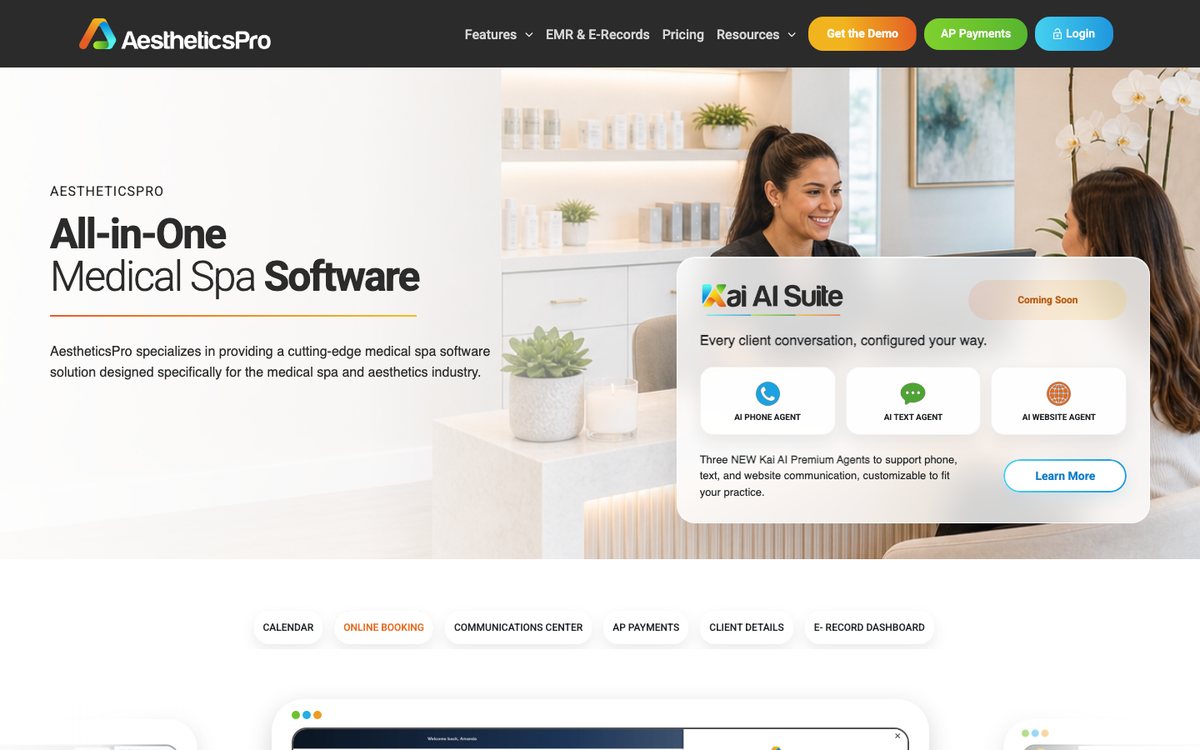
AestheticsPro has supported medical spas and aesthetic clinics for 15+ years, offering a HIPAA-compliant EMR that is widely regarded as easy to learn and use. It is a strong fit for solo and small med spas that prioritize simplicity and core clinical workflows.
Key features:
- Clinical EMR: HIPAA-compliant EMR with customizable treatment forms, digital consent, and before-and-after photo storage.
- Scheduling & Intake: Built-in online scheduling, digital intake forms, and lead tracking.
- Financial Reporting: Real-time financial dashboards and business reporting.
- Staff Management: Staff scheduling, timesheets, commission tracking, and basic payroll management.
Pros:
- Clean, intuitive interface that reviewers say is easy for new staff to learn.
- Built exclusively for med spas rather than adapted from a salon or general medical platform.
- Straightforward base pricing with fewer unexpected fees than many competitors.
Cons:
- Marketing automation and API/integration options are more limited than those of newer platforms.
- Clinical reporting covers core needs but lacks the advanced analytics offered by more established solutions.
- Per-user pricing on lower tiers can become costly as additional providers are added.
Pricing:
- Pro-Plus: $160/month (2 users included, $85/additional user, caps at 3 users).
- Executive: $285/month (unlimited users).
- Enterprise: $350/month (unlimited users).
Free trial details:
No free trial published. AestheticsPro offers a guided demo and structured onboarding with a client success manager.
8. WellnessLiving
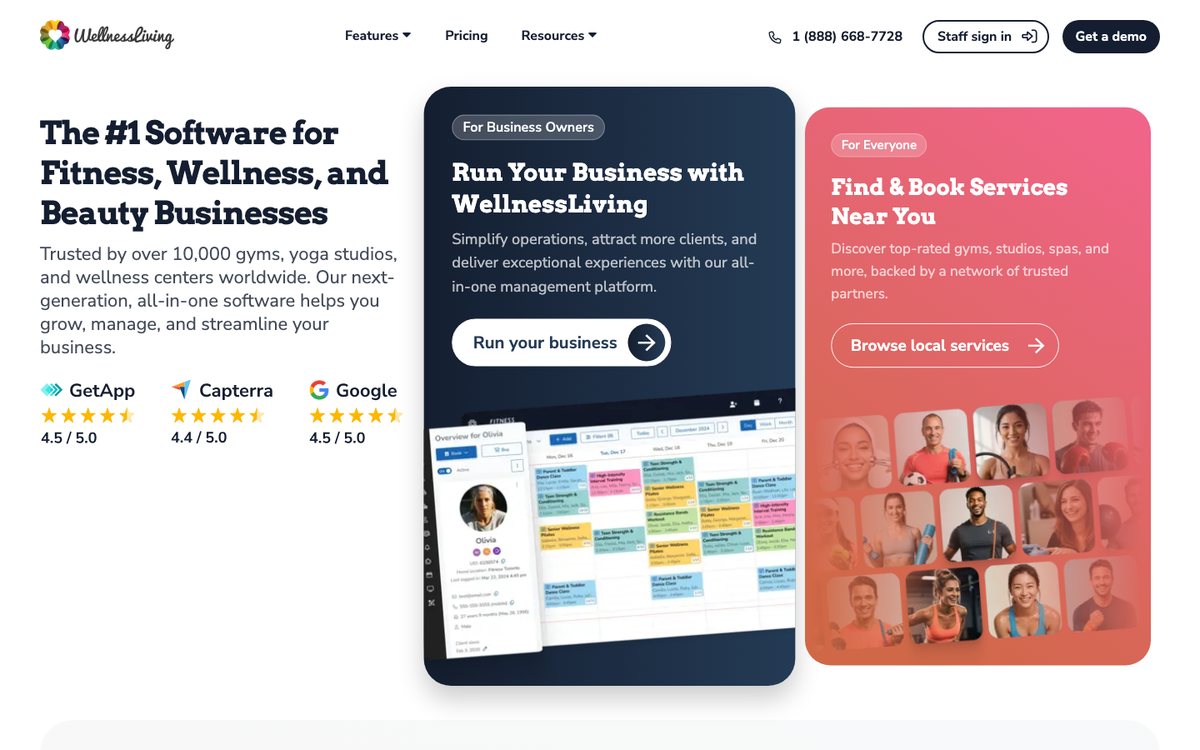
WellnessLiving is an all-in-one platform for fitness studios, yoga, Pilates, and wellness centers that focuses on scheduling, client management, and business operations. It is well suited to non-clinical businesses but does not include medical charting for services such as injectables or weight-loss treatments.
Key features:
- Scheduling & App: Class and appointment scheduling with a branded client mobile app available on higher tiers.
- Membership Management: Loyalty programs and automated membership renewals.
- Marketing Automation: Email/SMS campaigns and reputation management tools.
- Client Experience: Self-service kiosks and mobile check-in to reduce front-desk workload.
Pros:
- More affordable than Mindbody for similar studio-focused features, according to reviewer comparisons.
- Strong loyalty and membership tools for class-based and recurring-visit businesses.
- Responsive, highly rated customer support based on user feedback.
Cons:
- Offers SOAP and QUICK notes, but has no injection tracking, e-prescribing, or aesthetics-specific EMR built in.
- The $39 and $69 rates are two-month introductory prices; list rates are $199 and $349.
- Certain retention features require higher-tier plans.
Pricing:
- Starter: $69/month.
- Business: $199/month list, with a $39/month introductory rate for the first two months.
- BusinessPro: $349/month list, with a $69/month introductory rate for the first two months.
- Enterprise: Custom quote.
Rates checked September 2026.
Free trial details:
WellnessLiving does not publish a self-serve trial; prospective customers go through a guided demo.
How did we evaluate these platforms
Here is what shaped these rankings, in order of weight:
- Clinical depth stress test: For any platform claiming to serve med spas, we checked whether injection mapping, weight-loss tracking, and e-prescribing were native features or a marketing claim resting on a generic “custom forms” builder. This is the single biggest differentiator in this category, and it’s the one most comparison articles gloss over.
- Total cost of ownership: whether pricing is per calendar, per user or per location, because the three models diverge sharply as a practice grows.
- Compliance audit trail: explicit HIPAA/BAA language, consent form workflows, and audit logging, not just a "HIPAA-compliant" badge on the homepage.
- Support responsiveness: published reviewer feedback is weighed against vendor marketing claims, because post-sale support is where the two most often diverge.
- Data portability check: We specifically looked for reports of data export fees or lock-in friction, since switching costs are rarely disclosed upfront and can quietly trap a growing practice.
- Marketing automation depth: Beyond "email reminders," we checked whether each platform could run a full patient recall and reactivation campaign without a bolt-on tool.
- Onboarding timeline: We noted reported implementation windows, since a platform that takes four months to go live has a very different cost profile than one you can run appointments through in a week.
How to choose the right wellness center management software
Selecting the right platform starts with understanding your practice type, growth stage, and operational needs. The best choice is the one that aligns with your workflow, compliance requirements, and long-term goals:
- Clinical Practices: If you perform injectables, weight-loss treatments, or regulated procedures, choose platforms with native clinical charting to avoid costly and risky compliance fixes later.
- Solo Providers: Prioritize low switching costs and a bundled EMR over enterprise features you may not need in the first 1 to 2 years.
- Multi-Location Practices: For 3+ locations, compare multi-location capabilities and pricing, with options based on whether your business is salon-style or clinically driven.
- Fitness Businesses: If you are fitness- or class-based without clinical services, marketplace exposure may be more valuable than an unused medical EMR.
- Total Cost Review: Ask vendors about per-location fees, SMS/marketing add-ons, payment processing rates, and data export costs before signing.
Pick the right wellness center management software
Choosing the right wellness center management software depends on whether your business needs clinical depth, business automation, or simple scheduling. Fitness-focused platforms may function well for non-clinical businesses, while medical practices need native EMR capabilities to support compliance, patient care, and growth.
For med spas, aesthetic clinics, and wellness practices performing medical treatments, PatientNow stands out as the strongest all-in-one solution. It combines HIPAA-compliant EMR, marketing automation, scheduling, payments, AI tools, and practice management into a single platform, removing the complexity of managing multiple disconnected systems.
Ready to simplify your practice and grow faster? Find out how PatientNow can support your next stage of growth.
Frequently asked questions
Do I need clinical software, or will a scheduling platform do?
If your practice performs injectables, prescribes, orders labs, or documents treatment outcomes, you need clinical software. The test is not the size of the practice but whether a regulator would expect a medical record.
Scheduling-first platforms handle bookings, payments and retail well. What they do not carry is HIPAA-grade charting, injection mapping, e-prescribing or consent workflows tied to the patient record. Practices that start on one and add medical services later usually face a data migration they did not plan for.
Buy for the services you will offer in two years, not the ones you offer today.
What does wellness center software actually cost to run?
The subscription is rarely the whole cost. Three things move the real number: whether pricing is per location, per user or per calendar, whether SMS and email are metered separately, and what payment processing is charged on top.
A solo provider and a three-location group can pay very different effective rates on platforms that advertise the same headline price. Per-calendar pricing looks cheap for one provider and climbs quickly with treatment rooms.
Ask any vendor for a quote modeled on your actual provider count, location count and monthly message volume before comparing to anything else.
How long does it take to switch platforms?
Plan for weeks, not days, and the clinical data is the long pole. Scheduling and client records usually migrate cleanly. Treatment notes, consent forms and before-and-after photography are where migrations stall, because formats rarely map one to one.
Ask what the vendor migrates for you, what you are expected to export yourself, what format you get it in, and whether historical photos carry across attached to the right patient record.
Practices that migrate mid-quarter and keep the old system read-only for a month have the smoothest transitions.
What's the difference between wellness center software and med spa software?
Wellness center software serves fitness studios, yoga centers, and spas without clinical needs, and med spa software is designed for medical practices. It includes HIPAA-compliant EMR features, such as charting, injection tracking, and e-prescribing for treatments including Botox, fillers, and laser procedures.
Do I need a separate EMR if I use a platform like Mindbody or WellnessLiving?
Yes, in most cases. Both offer SOAP notes, but neither has injection mapping, e-prescribing or an aesthetics-specific EMR built in; Mindbody routes those through third-party integrations, so clinical practices end up running a second system, with additional costs and duplicate data entry.
Which of these platforms offer a free trial?
Only Vagaro publishes a self-serve trial (30 days). Every other platform here, including PatientNow, requires a demo call before accessing pricing or trial options.
Can I switch platforms later without losing my patient data?
Usually, but confirm data export policies first. Export policies and any associated fees vary by vendor, so ask about data portability before signing a contract.
Do multi-location practices pay more per location across all platforms?
Most platforms price per location, so a 5-location group may pay five times the base subscription cost before negotiations. PatientNow quotes per practice on two plans, Essentials and Pro; Pabau prices per user, and multi-site terms should be confirmed with sales.
Is PatientNow worth it compared to per-user or per-calendar platforms like Pabau or Vagaro?
It depends on your practice needs. PatientNow suits practices seeking deep aesthetics-specific clinical tools, marketing, and proven scalability, while smaller teams may prefer Pabau’s per-user model.
Explore this post
Book a demo to see PatientNow in action