Quick summary
Missed calls, overloaded front desks, and disconnected systems can cost medical and wellness practices valuable bookings and revenue. AI receptionists solve these challenges by answering calls 24/7, booking appointments, and recovering missed leads via text messaging. They integrate with scheduling and patient record systems to streamline operations and improve the patient experience.
Why are medical and wellness practices turning to AI receptionists
A ringing phone that nobody picks up is the most expensive sound in a wellness clinic. Front desk teams are already juggling check-ins, consults, and same-day reschedules, and every unanswered call during that chaos is a booking that may never come back.
That's the gap AI receptionists are built to close. They answer every call, text back missed ones, and book straight into your calendar, 24 hours a day. This guide covers phone-based AI receptionists; web chat and messaging tools are covered separately. Here we’ve compared 9 AI receptionist platforms built for or actively used by medical and wellness centers across call-handling quality, scheduling, EHR integration, HIPAA compliance, and pricing transparency. For a broader look at AI across the practice, see our guide to medical spa AI tools.
Why trust us
For 20+ years, PatientNow has helped wellness centers, med spas, and other aesthetic practices manage the clinical and business sides of their operations. That experience, combined with AI automation powered by Recura, provides a firsthand understanding of the challenges practices face, from missed calls and fragmented systems to after-hours lead management and patient retention.
This comparison is based on the features and capabilities that matter most day to day: call handling, appointment booking, EMR integration, HIPAA compliance, marketing automation, and overall workflow efficiency. Our goal is to help practices choose the solution that best fits their operational needs while highlighting what drives better patient experiences and stronger business outcomes.
What is an AI receptionist for a medical or wellness center
An AI receptionist is software that answers calls and messages, understands caller requests in natural language, and books, reschedules, cancels, or routes calls to staff without human intervention.
In medical and wellness practices, it must also manage HIPAA-covered information responsibly, and recognize when a caller needs a nurse or provider. It must also update the practice’s existing scheduling system or EMR instead of creating a separate calendar.
Why are medical and wellness centers adopting AI receptionists
Medical and wellness practices are under increasing pressure to deliver fast, reliable patient experiences without adding more administrative staff. AI receptionists help bridge that gap. Here’s how:
- Recovering after-hours and peak-time calls: Consult requests that come in after hours or during busy front-desk periods are answered and booked, rather than going to voicemail.
- Turning missed calls into booked consults: Missed-call text-back features re-engage callers within seconds, rather than relying on them to call again.
- Reducing front desk burnout: AI handles routine questions about pricing, provider availability, and pre-treatment instructions, freeing staff to focus on in-person care.
- Protecting revenue at scale: For multi-location practices, every answered consult call helps preserve treatment opportunities worth hundreds or even thousands of dollars in lifetime client value.
Comparison chart for 9 best AI receptionists for medical and wellness centers
The table beneath provides a side-by-side comparison of the top 9 AI receptionist platforms for medical and wellness practices:
| Platform | Key strength | Voice AI calls | Text-back on missed call | EHR/ |
Marketing automation | HIPAA support (as stated by each vendor) | Built for medical/ |
|---|---|---|---|---|---|---|---|
| PatientNow (Recura) | Native AI receptionist within an all-in-one EMR, CRM, and marketing platform for medical and wellness practices | Yes | Yes | Yes (native) | Yes | Yes | Yes |
| Zenoti AI Receptionist | Well suited to multi-location practices already using the Zenoti ecosystem | Yes | Yes | Partial (Zenoti ecosystem) | Yes | Yes, Zenoti states it provides a signed BAA for med spa clients | Yes |
| Weave | AI call handling built into a healthcare communications platform | Yes | Yes | Partial (via integrations) | Limited | Yes, Weave publishes a BAA | No (general healthcare) |
| DeepCura | Combines AI receptionist with clinical scribing, coding, and billing | Yes | No | Yes (multiple EHRs) | No | Yes, BAA included per DeepCura | No (clinical/ |
| Smith.ai | Hybrid AI and live human receptionist support | Yes (AI + human) | Yes | No | No | No. Smith.ai states it is not HIPAA-compliant and cannot handle PHI | No (general professional services) |
| Simbie AI | Purpose-built for high-volume medical call automation | Yes | No | Limited | No | Yes, per Simbie | No (clinical/ |
| Podium AI Employee | AI receptionist bundled with reviews and customer messaging | Yes | Yes | No | Limited | Yes, per Podium (aesthetics.podium.com); Podium publishes a standard BAA | No (general local business) |
| Emitrr | Affordable AI receptionist for independent practices | Yes | Yes | Partial (via integrations) | Limited | Yes, per Emitrr | Partial (independent practices) |
| Phonely AI | Voice-first AI receptionist with flexible CRM and scheduling integrations | Yes | Yes | Partial (via integrations) | No | Yes, per Phonely | Partial (healthcare and wellness) |
9 best AI receptionists for medical and wellness centers explained
Every practice has different priorities, from reducing missed calls to simplifying clinical workflows. The following review will help you identify the AI receptionist that best aligns with your operational needs, growth goals, and patient experience.
1. PatientNow (Recura)
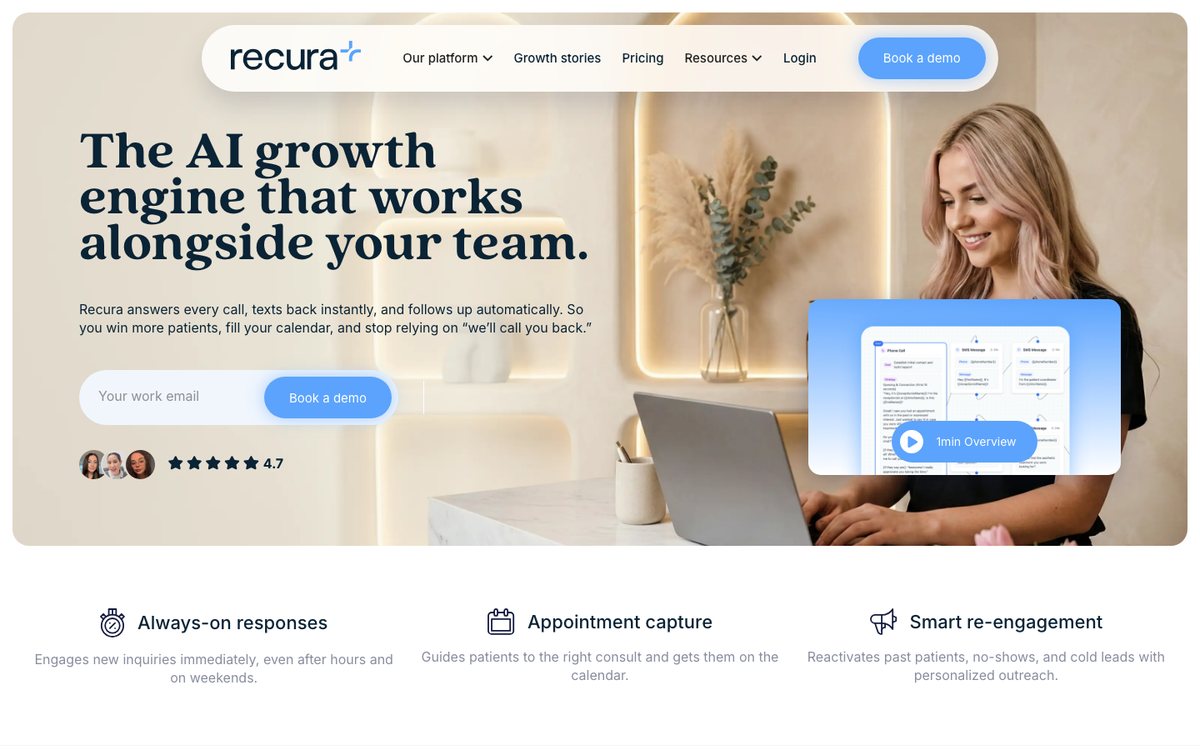
PatientNow combines AI automation powered by Recura AI with a purpose-built clinical-grade EMR, CRM, and marketing platform for medical and wellness centers. Unlike standalone AI receptionists or general business phone systems, Recura works inside the same platform that manages patient records, scheduling, marketing, payments, and clinical workflows.
It answers calls, texts, and web chats 24/7, responds to new inquiries in seconds, qualifies leads, and books, reschedules, or cancels appointments directly in your live calendar. Because every interaction is connected to the patient's record, the AI can provide contextual responses, automate follow-up, and help convert more inquiries into booked appointments without adding to your front desk's workload.
Key features:
- 24/7 AI receptionist: Answers calls, texts, and web chat around the clock so no inquiry goes unanswered.
- Automated booking & follow-up: Books, reschedules, cancels appointments, qualifies leads, and nurtures patients using the practice's live schedule and client records.
- Two-way SMS & missed-call recovery: Converts missed calls into text conversations with automated Concierge outreach to recover lost bookings.
- Waitlist automation: Instantly alerts patients when preferred appointment times become available, helping fill cancellations faster.
- Built-in marketing automation: Combines AI reception with drip campaigns, reputation management, lead nurturing, and AI content creation in one platform.
- Clinical-grade EMR integration: Connects every interaction to a HIPAA-compliant EMR with injection tracking, e-prescribing, RxPhoto management, and treatment history.
- Centralized dashboard & reporting: Tracks conversations, call-to-booking conversions, and KPIs from a single dashboard.
Pros:
- Replaces separate AI receptionist, CRM, EMR, and marketing tools with one integrated platform.
- Actually books appointments, not just answers questions, with deep calendar integration.
- Built exclusively for medical and wellness practices, with every Recura agent trained on your services, pricing, promotions, FAQs, and brand voice.
- Captures after-hours and missed-call leads automatically to protect speed-to-lead and increase bookings.
- U.S.-based support team, with onboarding and training included.
Cons:
- Delivers the most value when used as part of the full PatientNow platform rather than as a standalone AI receptionist.
- Multi-location practices with existing systems may need to migrate their scheduling data to achieve full integration.
Integrations:
- Native EMR & CRM, scheduling/calendar, VoIP, SMS, web chat, RxPhoto, QuickBooks, e-prescribing, telehealth, lab integrations (120+ vendors), integrated payments, Google booking, AI marketing automation. Recura also syncs PatientNow data for AI outreach and rebooking.
Pricing:
- PatientNow offers custom pricing. Contact the team for a personalized quote. Recura AI is available as an add-on.
2. Zenoti
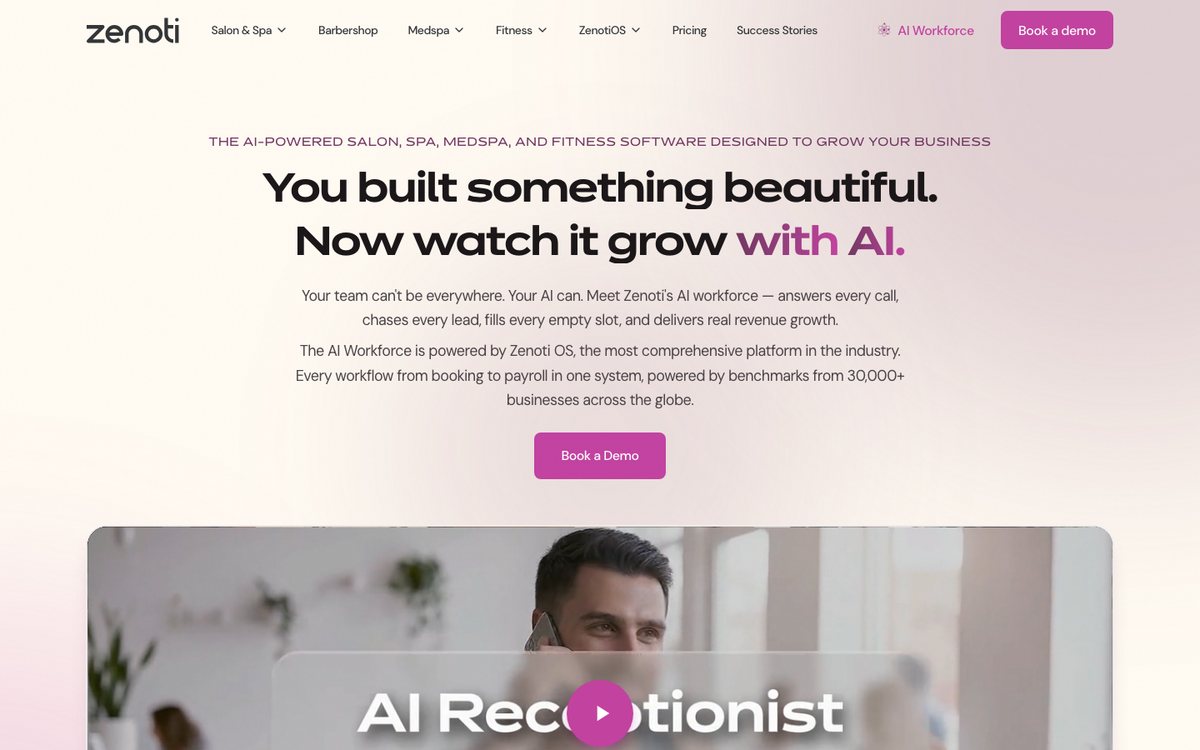
Built into the Zenoti platform, the AI Receptionist is well suited to multi-location medical and wellness chains already using Zenoti’s enterprise platform for scheduling, payments, and staff management.
The AI answers missed calls, re-engages callers via text, and handles booking, rescheduling, and waitlist placement using live calendars across all locations. Its deep integration is an advantage for enterprise practices, but it is designed for existing Zenoti users rather than as a standalone AI receptionist.
Key features:
- Missed-call recovery: Automatically responds to missed calls with two-way SMS that can complete bookings in real time.
- Appointment management: Books, reschedules, and adds clients to waitlists without requiring an app or login.
- Call recovery: Zenoti says its AI receptionist converts one in three missed calls into appointments.
- Enterprise AI integration: Connects to Zenoti’s AI suite, including AI Scribe and AI Lead Manager, for practices that use the full platform.
Pros:
- Deep integration with Zenoti’s scheduling, memberships, and multi-location management.
- Proven across a large network of salon, spa, and med spa businesses.
- Lets clients complete bookings without downloading an app.
Cons:
- Suited to practices already using or planning to adopt Zenoti.
- Custom pricing requires a demo and has no published starting rate.
- Less suited to practices that need the advanced clinical features of a medical-specific EMR.
Integrations:
- Native Zenoti scheduling, POS/payments, memberships, CRM, marketing, AI Scribe, AI Lead Manager, open API for third-party integrations.
Pricing:
- Custom, based on location count, service mix, and team size. No public starting price. Requires a demo request.
3. Weave

Weave is a good choice for medical and wellness practices that already use its phone, texting, and reputation management platform and are looking to add AI call handling. As a healthcare communications platform, Weave combines VoIP, two-way texting, reviews, and AI-powered appointment scheduling with growing EMR integrations.
Its AI receptionist functions well within the broader Weave ecosystem, although it comes as part of a bundled communications platform rather than a standalone, purpose-built receptionist product.
Key features:
- AI appointment booking: Schedules appointments directly against the practice calendar.
- Missed-call automation: Converts missed calls into two-way text conversations to recover potential bookings.
- EMR integration: Weave's platform integrates with Dentrix, Nextech and DrChrono among others; the AI Receptionist itself is currently limited to Dentrix, Eaglesoft and Open Dental.
- Call insights: Includes call analytics and voicemail-to-email within the core communications platform.
Pros:
- Combines phone, texting, reviews, and AI receptionist features in one platform.
- Suited for practices seeking unified staff and patient communication.
- Backed by a large healthcare customer base with ongoing AI development.
Cons:
- AI Receptionist is in early access for Dentrix, Eaglesoft and Open Dental users; practices on other systems join a waitlist (getweave.com/ai-receptionist, September 2026).
- Separate AI pricing is not published and requires a sales consultation.
- Built for general healthcare communication rather than medical or wellness-specific workflows.
Integrations:
- Integrates with major healthcare PM/EHR systems, including Dentrix, Nextech, DrChrono, plus VoIP, SMS, online scheduling, reviews, and patient communication tools.
Pricing:
- Not published. Weave lists Pro, Elite and Ultimate plans with pricing on request; AI Receptionist pricing is not shown on the pricing page, and early-access customers are offered 25% off for the rest of 2026.
4. DeepCura

DeepCura combines AI call answering with ambient clinical scribing, coding, and billing. This makes it a good choice for practices that want both reception and documentation from one vendor.
Its AI receptionist is part of a broader clinical AI platform with integrations with systems such as Epic, eClinicalWorks, and Athena. For documentation-heavy practices such as dermatology or family medicine, this bundled approach can replace multiple standalone tools with a single platform.
Key features:
- AI call handling: Manages live calls with identity verification and payment link delivery.
- Built-in AI scribing: Includes ambient clinical scribing and note generation in the same platform.
- EHR integrations: Connects with Epic, eClinicalWorks, OptiMantra, and Athena.
- Practice-specific responses: Uses a custom knowledge base to answer practice-specific questions instead of generic scripts.
Pros:
- Combines AI call handling and clinical documentation in one subscription.
- Integrates with a wide range of EHR systems.
- Offers transparent flat-rate pricing per provider.
Cons:
- Designed for general clinical practices rather than medical and wellness-specific workflows.
- Smaller established user base than legacy medical software vendors.
Integrations:
- Integrates with Epic, eClinicalWorks, Athenahealth, OptiMantra, and AI scribing, coding, billing, and clinical documentation workflows.
Pricing:
- Base plan $129 per provider per month, with the AI receptionist included (deepcura.com, September 2026).
5. Smith.ai
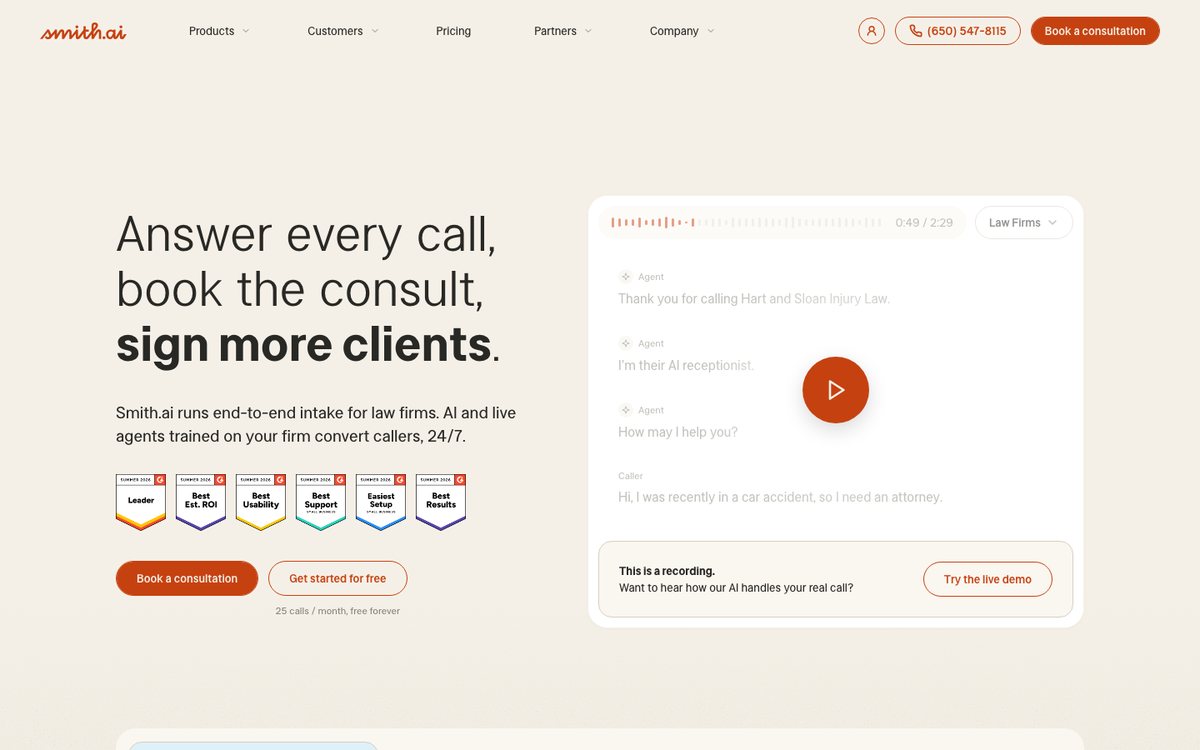
Smith.ai combines AI call handling with live, North America-based receptionists, making it a good option for practices that want a human on complex calls that do not involve protected health information.
Routine calls are handled by AI, while complex inquiries are escalated to live agents. This hybrid approach functions well for practices that value a human touch, though its per-call pricing can become costly as call volumes grow.
Key features:
- Hybrid call handling: AI manages routine scheduling and FAQs, while complex calls are transferred to live agents.
- Compliance boundary: Smith.ai states that it is not HIPAA-compliant and cannot handle protected health information, so it suits healthcare-adjacent front-desk work rather than regulated PHI.
- Usage-based pricing: Uses a per-call pricing model that scales with call volume.
- Industry-specific service: Provides dedicated answering services tailored for spa and med spa practices.
Pros:
- Provides live human support for complex calls.
- Covers after-hours and overflow calls without additional in-house staff.
- Well-established virtual receptionist service with AI capabilities.
Cons:
- Per-call pricing becomes expensive as call volume increases.
- Not HIPAA-compliant, per Smith.ai’s own medical and wellness page, so it cannot take calls that involve protected health information.
- Lacks native integration with EHRs and medical and wellness scheduling platforms.
Integrations:
- Connects with HubSpot, Salesforce, HighLevel, ActiveCampaign, Keap, Pipedrive, Zoho CRM, Slack, Microsoft Teams, Google Calendar, Jane, Mindbody, Zapier/Make, and many other CRM and scheduling platforms.
Pricing:
- Free: 25 calls/month.
- Pro: Starting at $150/month for up to 75 calls.
- Enterprise: Starting at $500/month for up to 300 calls.
Per-call charges apply above each plan’s allowance.
6. Simbie AI
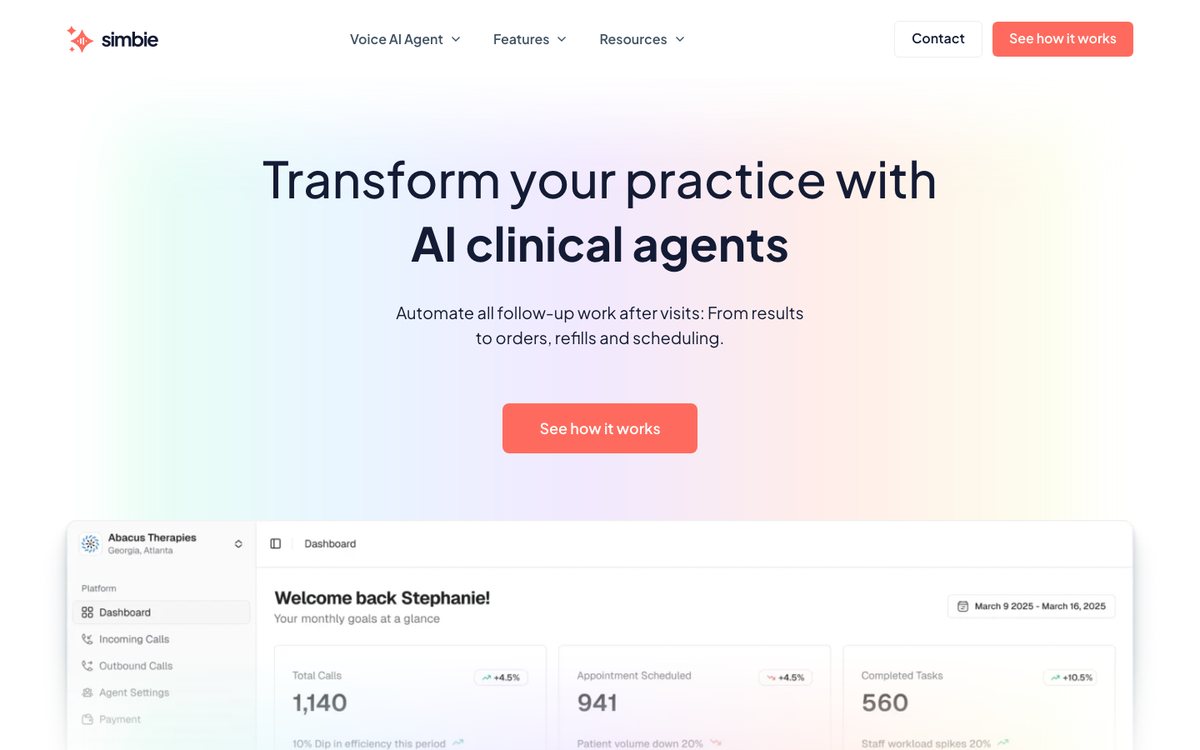
Simbie AI is built for medical practices with high inbound call volumes that need dedicated phone automation. It focuses on scheduling, patient intake, insurance verification, and prescription refill requests while handling multiple calls simultaneously.
The AI’s usage-based pricing can be cost-effective for busy clinics, though practices will still need separate tools for clinical documentation, deeper EHR workflows, and marketing.
Key features:
- High-volume call handling: Manages multiple inbound calls simultaneously without long wait times.
- Workflow automation: Automates appointment scheduling, patient intake, and insurance verification.
- Usage-based pricing: Charges based on actual call volume rather than a flat subscription fee.
- Medical-focused AI: Uses natural voice conversations designed for common medical call scenarios.
Pros:
- Suited for high-volume clinics with heavy inbound call traffic.
- Usage-based pricing scales with demand.
- Strong natural language handling for medical-specific calls.
Cons:
- Does not include AI scribing, note generation, or billing features.
- Costs can rise with consistently high call volumes.
- Offers fewer EHR integrations than full-stack platforms.
Integrations:
- Integrates with Epic, Athenahealth, eClinicalWorks, scheduling systems, insurance verification workflows, and practice management software (integration availability varies by deployment).
Pricing:
- Usage-based, billed per call handled. No flat published rate.
7. Podium AI Employee
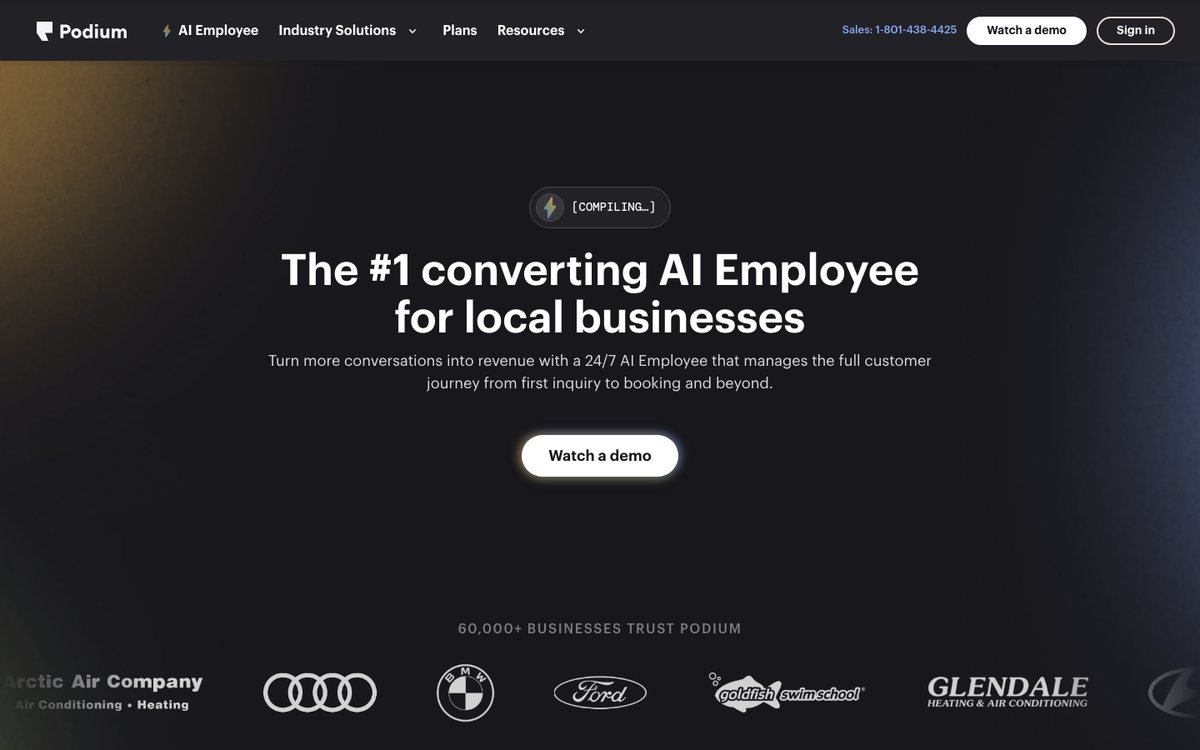
Podium AI Employee is a good fit for wellness centers that want AI phone handling, review management, and customer messaging in a single platform. As part of the broader Podium platform, it answers inbound calls, routes leads, and books appointments while integrating with review requests and multichannel messaging. Its bundled approach functions well for practices that adopt the full Podium ecosystem rather than a standalone AI receptionist.
Key features:
- AI call handling: Answers calls and routes leads through Podium's unified messaging inbox.
- Customer messaging: Combines review management with SMS and web chat on a single platform.
- Lead capture: Converts website chat inquiries and phone interactions into leads.
- Reputation management: Includes AI-generated review responses and reputation tools in higher-tier plans.
Pros:
- Adds AI call handling to Podium's reviews and messaging platform.
- Brings calls, texts, and reviews into a single inbox.
- Helps speed up lead response times with AI automation.
Cons:
- Requires a Podium subscription and is not available as a standalone tool.
- Costs can rise with add-ons and multi-location fees.
- Aesthetics-specific EMR features sit in the separate Podium Aesthetics product rather than the core platform.
Integrations:
- Integrates with Mindbody, Nextech, DrChrono, HubSpot, Google Business Profile, Meta, website chat, SMS, reviews, and lead messaging.
Pricing:
- Custom pricing for Podium. Add-ons like Podium AI Employee cost extra.
8. Emitrr
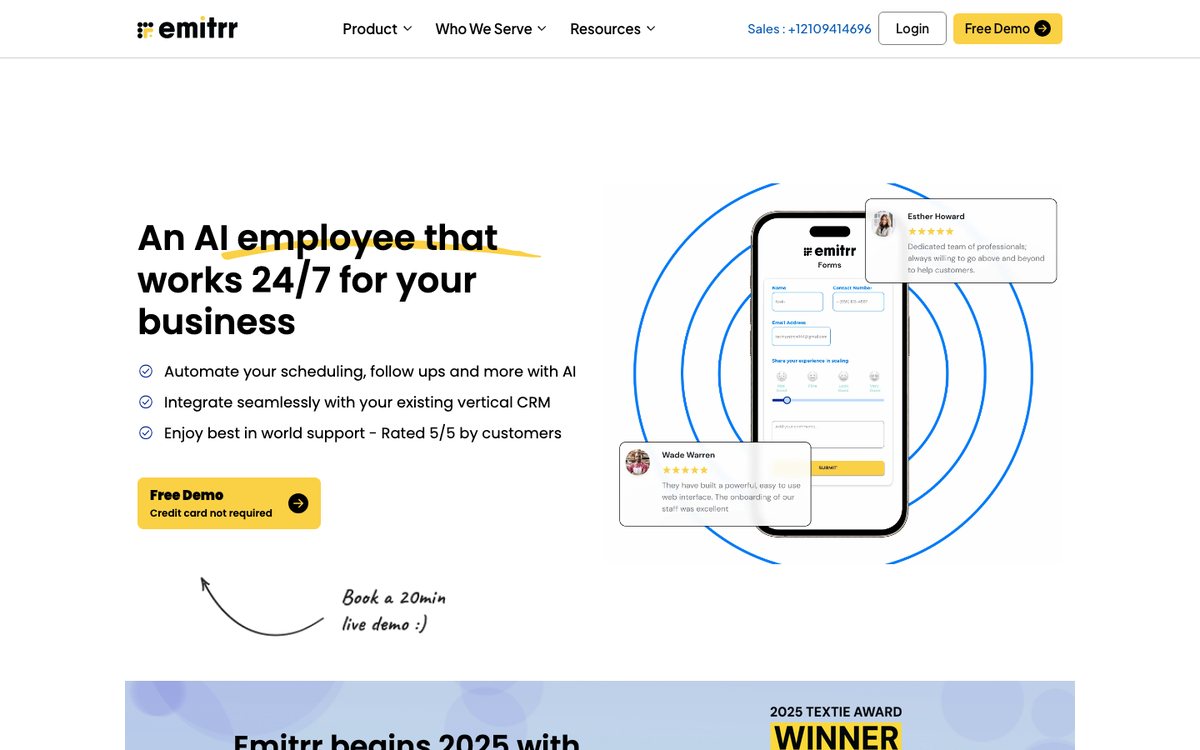
Emitrr is a budget-friendly option for independent practices that want AI call answering alongside patient communication and review management. Its AI is part of a broader platform that includes appointment reminders, no-show reduction, and online reviews.
Emitrr is less advanced at handling complex conversations than voice-first AI platforms. But it offers an affordable way for small practices to reduce missed calls and improve patient communication.
Key features:
- AI call handling: Answers calls, takes messages, and schedules appointments.
- Unified inbox: Brings calls, texts, and online reviews into one place.
- Appointment reminders: Sends automated reminders to help reduce no-shows.
- Reputation management: Includes review requests and online reputation tools in the same platform.
Pros:
- Affordable and easy to set up for independent practices.
- Combines missed-call recovery, appointment reminders, and reputation management.
Cons:
- Pricing is quoted per practice rather than published.
- Limited support for complex, multi-turn conversations.
- Lacks clinical AI and scribing.
Integrations:
- Integrates with healthcare EHR/practice management systems including Athenahealth, eClinicalWorks, AdvancedMD, Dentrix, Eaglesoft, Open Dental, plus Google Business Profile, VoIP, SMS, payments, and review platforms.
Pricing:
- Free demo. Custom pricing, depending on call volume and selected features.
9. Phonely AI
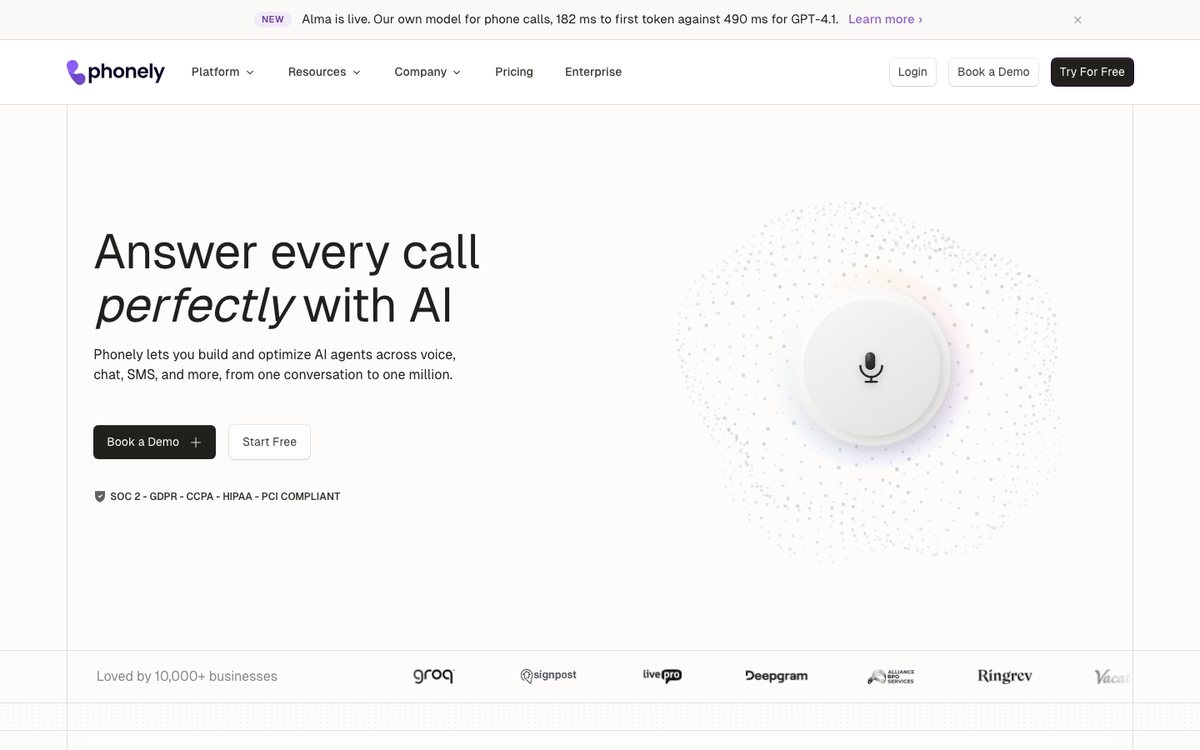
Phonely AI is a voice-first AI receptionist for healthcare and wellness practices that want fast phone automation with flexible integrations. It automates inbound calls by answering instantly, scheduling appointments, qualifying callers, and handling routine requests.
The AI supports multiple simultaneous conversations and integrates with existing practice software. It’s a good fit for clinics that want AI call handling without replacing their current systems.
Key features:
- 24/7 AI call answering: Answers every call instantly and manages multiple conversations at once.
- Appointment scheduling: Books appointments and sends automated reminders.
- Patient follow-up: Automates follow-up calls and messages to improve retention.
- Custom integrations: Connects with practice management software and other business tools.
Pros:
- Voice AI phone answering with healthcare and wellness among its published use cases.
- Answers calls 24/7 with unlimited call concurrency.
- Strong analytics and reporting for monitoring call performance.
Cons:
- Does not include a native EMR, CRM, or marketing platform.
- Enterprise volumes move to per-minute pricing, quoted on request.
- Practices that require clinical charting or patient management will still need separate software.
Integrations:
- Integrates with HubSpot, Salesforce, Google Calendar, Cal.com, Zapier, Make, Twilio, OpenPhone, GoHighLevel, Slack, and custom applications through its API and webhooks. It also connects with existing CRM, scheduling, and practice management systems.
Pricing:
- Free: 100 minutes and ~50 calls.
- Starter: $50/mo (200 min and ~100 calls).
- Professional: $150/mo (650 min and ~300 calls).
- Enterprise: as low as 5¢ per minute, billed monthly. Book a demo.
How did we evaluate the AI receptionists
We didn’t score every platform against a generic “does it answer the phone” checklist. Rather, we weighted our evaluation toward what actually determines whether an AI receptionist earns its keep in a medical or wellness setting:
- Does the AI act on the calendar it’s connected to, or just take a message? A tool that books directly into a live schedule removes work from the front desk. One that only routes a message to staff for manual entry adds a second step instead of removing one.
- What happens when the AI hits its limit? Whether that’s a warm transfer to a live person, a graceful skip, or an infinite re-ask loop matters more day-to-day than how natural the AI’s voice sounds.
- Is the AI trained on the practice’s vocabulary, or on generic small-business FAQs? A caller asking about filler longevity or pre-treatment instructions needs different handling than a caller booking a haircut.
- Does adopting the AI mean adopting an entire new platform, or does it plug into what the practice already runs? This is the line between a tool that reduces total software spend and one that adds a new subscription to an already fragmented stack.
How to choose the best AI receptionist for your practice
Picking the best AI receptionist means selecting one that solves your practice’s biggest operational challenges while fitting cleanly into your existing workflow. Before making a decision, take into account the following variables:
- Identify your biggest revenue leak: If missed after-hours calls are the problem, prioritize platforms with real-time booking and missed-call text-back, such as PatientNow or Zenoti.
- Match the platform to your workflow: If clinical documentation is the bigger challenge, a bundled solution like DeepCura may provide more value than a phone-only AI receptionist. For complex conversations that benefit from a live person, consider a hybrid AI-and-human service like Smith.ai, noting its stated HIPAA limits.
- Choose an integrated platform: For aesthetics and wellness practices, the greatest value comes from keeping the AI receptionist, patient records, and marketing within a single system. This removes the manual work of connecting separate phone, EMR, and marketing tools.
- Check scheduling and EMR integrations: Make sure the AI works with your existing scheduling software or EMR so appointments, patient records, and updates stay synchronized without manual entry.
- Prioritize HIPAA compliance: Choose a platform that supports HIPAA-compliant call handling, messaging, and patient data management to help protect sensitive health information.
- Evaluate conversation quality: Look for AI that can understand natural language, answer practice-specific questions, and know when to transfer callers to a live staff member.
- Consider scalability: If you operate multiple locations or expect to grow, choose a platform that can manage shared calendars and locations and handle increasing call volumes without adding complexity.
- Compare total cost, not just the starting price: Factor in setup fees, add-ons, usage charges, and integration costs, rather than focusing only on the advertised monthly rate.
- Review reporting and analytics: Look for dashboards that track missed calls, booking rates, call conversions, and other metrics to measure the AI's impact on revenue.
- Assess implementation and support: Consider how quickly the platform can be deployed and whether the vendor offers responsive onboarding, training, and customer support for your practice.
Pick the best AI receptionist to stop missing patient calls
Choosing the right AI receptionist boils down to your medical and wellness practice's workflow, call volume, and technology stack. Some platforms are good at enterprise scheduling. Others focus on clinical documentation or hybrid AI-human support, and budget-friendly options prioritize basic call handling and patient communication. The best solution is one that not only answers every call but also integrates directly with your scheduling and patient records. It should also be able to follow up on processes to reduce administrative work and improve the patient experience.
Specifically for medical and wellness practices, PatientNow is the strongest overall choice. Unlike platforms that only add AI to an existing phone system, it combines AI call handling with a native EMR, CRM, marketing automation, and revenue management platform. The platform integrates appointment scheduling, patient records, marketing, and AI reception into a single connected system, which removes the fragmented workflows that often lead to missed opportunities and extra administrative work.
Schedule a demo today to see how PatientNow can help your practice capture more bookings while reducing front-desk workload.
What can answer my practice's calls after hours
An AI receptionist answers the call rather than sending it to voicemail. It picks up at any hour, understands what the caller is asking in plain language, and books the appointment into the live schedule instead of leaving a message for someone to action the next morning.
The distinction that matters is whether the tool writes to your calendar or only records a request. A system that books removes work from the front desk. One that routes a message for manual entry adds a step instead of removing one.
For practices where most missed calls arrive in the evening or during treatments, after-hours coverage is usually the largest source of recoverable bookings.
What happens when the AI cannot answer a patient's question
It should hand the call to a person. The behavior to check before buying is what the system does at the edge of its knowledge: a warm transfer to a live staff member, a clean message capture with a callback commitment, or an endless loop of re-asking the same question.
That behavior matters more day to day than how natural the voice sounds. A caller who is politely handed to a human remembers a competent practice. A caller stuck repeating themselves remembers the opposite.
Ask any vendor to demonstrate the handoff specifically, not just the path where the AI knows the answer.
Do patients mind talking to an AI on the phone
Most do not, provided two conditions are met. The AI says what it is at the start of the call, and a human is reachable when the caller wants one. In some jurisdictions that disclosure is a legal requirement rather than a courtesy.
Patients are generally comfortable with software handling routine scheduling, confirmations and directions. Tolerance drops sharply when the caller has a clinical concern, a complaint, or is trying to reach a specific person and cannot get through.
Use AI for the routine volume, and make the route to a person short and obvious.
Will an AI receptionist sound robotic to patients
Voice quality has moved well past flat text-to-speech, but what usually makes a call feel robotic is the script, not the voice.
A system trained only on generic small-business phrasing will mishandle a caller asking about filler longevity, pre-treatment instructions, or downtime after a specific treatment. It answers confidently and wrongly, or it stalls.
When evaluating one, test it with your own vocabulary rather than the vendor's demo script. Ask about the treatments you actually offer and listen for whether the answers are yours or generic.
What if the AI says something wrong to a patient
This is the risk worth designing against, and the controls are straightforward.
Limit what the AI is permitted to discuss. Scheduling, hours, directions and general preparation are safe territory. Anything clinical should route to a person by design rather than by the AI's own judgment.
Ask the vendor how responses are constrained, whether the system is limited to an approved knowledge base or generating freely, and whether transcripts are reviewable so a wrong answer can be found and corrected rather than repeating silently.
Can an AI answer medical questions from patients safely
It should not try. An AI receptionist is a scheduling and communication layer, not a clinical one. Diagnosis, treatment suitability, medication questions and post-procedure concerns belong with a licensed provider.
The safe pattern is narrow and explicit. The AI recognizes a clinical question, says it will pass it to the care team, captures the detail, and escalates. What it must never do is improvise an answer that reads as medical advice.
When comparing platforms, ask what happens when a caller describes a symptom. The correct answer is a handoff, not a response.
How much does an AI receptionist cost for a small practice
Pricing follows three models, and the model matters more than the headline number.
Per call, which is predictable when volume is steady and expensive when it spikes. Per month for a set allowance, which is the most common and easiest to budget. Or bundled into a wider platform, where the AI is part of the subscription rather than a separate line.
Before comparing figures, ask what counts as a billable interaction, what happens when you exceed the allowance, whether setup or number porting is charged separately, and whether integration into your scheduling system costs extra. Two platforms at the same monthly price can differ substantially once those are included.
Compare the fee with the value of the bookings currently lost to unanswered calls, not with another vendor's monthly price.
Frequently asked questions
Is an AI receptionist HIPAA compliant?
Not automatically. Look for a signed Business Associate Agreement (BAA), encrypted call and message storage, and a clear policy on whether patient data is used for AI model training. Most platforms reviewed here will sign a BAA on request, but the terms and what they cover vary, so confirm specifics with the vendor before signing.
Can an AI receptionist integrate with my med spa’s booking or EMR software?
Most can, but the depth of integration varies widely. Platforms built specifically for medical and wellness centers, such as PatientNow, integrate natively with the same system that holds the client’s treatment history. General-purpose platforms like Weave or Podium typically integrate via add-on connections, which can lead to more setup and occasional sync gaps.
How much does an AI receptionist cost for a medical and wellness center?
Pricing varies by platform. DeepCura starts at $129 per provider per month. Smith.ai's AI receptionist plans start at $150 per month for up to 75 calls. Simbie AI uses usage-based pricing, Phonely publishes plans from $50 per month, and Emitrr, PatientNow, Zenoti, Weave, and Podium provide custom pricing based on practice needs and features.
Will my clients know they’re talking to an AI?
Most platforms include a brief disclosure at the start of the call, and in some jurisdictions this is a legal requirement, not just best practice. Clients are generally comfortable with AI handling routine scheduling, as long as they can reach a human when needed.
What’s the difference between an AI receptionist and a chatbot?
An AI receptionist typically handles live phone calls using voice AI and can act on a calendar in real time. A chatbot usually handles web chat or SMS conversations. Several platforms on this list, including PatientNow and Podium, combine both in a single system. So, a lead receives consistent handling regardless of which channel they use to reach out.
Explore this post
Book a demo to see PatientNow in action