Quick Summary
Dermatology practices in 2026 face growing pressure to manage hybrid insurance and cash-pay models, detailed photo documentation, compliance, and tighter margins. Therefore, the right dermatology practice management solution is crucial to simplify billing, clinical workflows, patient engagement, and reporting.
Your Dermatology Software Should Grow With You, Not Hold You Back
Dermatology practices operate at the intersection of medical and cosmetic care. You need hybrid billing that supports both insurance and cash pay, detailed photo documentation for skin conditions, and aesthetic treatments. In addition, you require precise procedure tracking, and reporting that protects margins.
Yet many generic EMRs aren’t built for this balance of clinical depth and business agility. But in this guide, we review 10 dermatology-focused EMR systems, comparing their features, strengths, and limitations, and pricing. So, you can choose software that supports your growth, not slows it down.
Why Listen to Us

PatientNow has spent 20+ years building software exclusively for aesthetic and dermatology practices. We’ve worked alongside hundreds of providers nationwide, giving us firsthand insight into the clinical, operational, and financial challenges dermatology teams face every day.
This review is grounded in real industry experience, verified user feedback, and deep competitive knowledge. So, you’re getting practical guidance from a company that understands both the medical and business sides of dermatology growth.
What Is Dermatology Practice Management Software?
Dermatology practice management software is a purpose-built platform that unifies clinical documentation, scheduling, billing, and patient communication in one system.
A strong platform handles:
- HIPAA-compliant charting.
- insurance and cash-pay billing.
- photo management for before-and-after comparisons.
- and patient engagement tools.
The best options also include reporting dashboards so owners can track revenue and patient retention without exporting data to spreadsheets.
10 Best Dermatology Practice Management Software Tools At A Glance
| # | Tool | Key Features | Good For |
|---|---|---|---|
| 1 | PatientNow | HIPAA-compliant EMR, marketing suite and AI automation. | Med spas and aesthetic practices. |
| 2 | EZDERM | Dermatology EMR, billing and teledermatology. | Dermatology-focused practices. |
| 3 | CureMD | Specialty workflows, billing and analytics. | Multi-specialty dermatology practices. |
| 4 | AdvancedMD | Dermatology workflows, billing and reporting. | Mid-sized to large dermatology groups. |
| 5 | Pabau | CRM, scheduling and marketing tools. | Aesthetic and cosmetic clinics. |
| 6 | DrChrono | Cloud EHR, revenue cycle management and a free API. | Insurance-based dermatology practices. |
| 7 | eClinicalWorks | Population health, billing and AI tools. | Large, multi-provider dermatology groups. |
| 8 | athenaOne | Cloud EHR, revenue cycle management and patient engagement. | Growing dermatology practices. |
| 9 | Nextech | Clinical EHR, scheduling and revenue cycle management. | High-volume plastic surgery and dermatology practices. |
| 10 | ModMed (Modernizing Medicine) | Specialty EHR, analytics and billing. | Specialty practices. |
Let’s discuss each tool in detail.
1. PatientNow
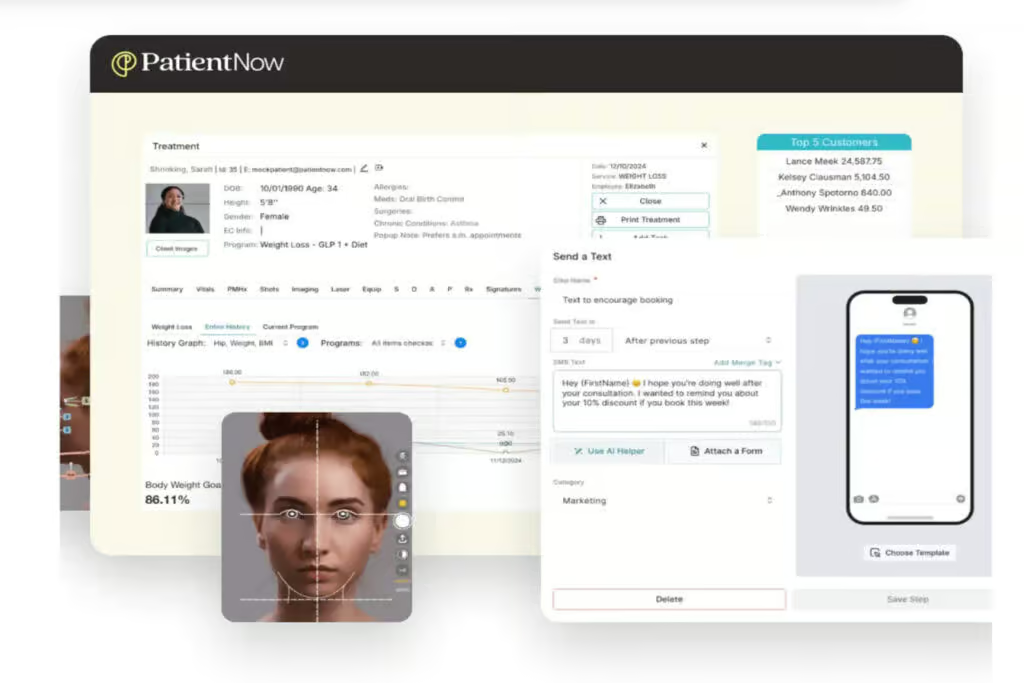
PatientNow is a clinical-grade, all-in-one platform built exclusively for aesthetic and medical spa practices since 2004. Unlike competitors retrofitted from general EMRs or salon tools, it replaces four to six separate tools with one unified system. The platform includes EMR, marketing automation, patient engagement, advanced photo management, scheduling, and payments.
Key Features
- HIPAA-compliant EHR: Get access to charting purpose-built for aesthetic and derm workflows for higher efficiency.
- Marketing Suite: Built-in lead capture, drip campaigns, reputation management, and AI content help you market your practice without breaking a sweat.
- AI Automation via Recura: Automates booking, lead follow-up, rescheduling, and patient nurturing 24/7.
- RxPhoto & Consultation Tools: Guided photo capture, markup/annotation, before-and-after comparisons, consultation center, and one-touch social sharing to improve treatment acceptance and documentation.
- Practice & Revenue Management: Memberships, loyalty programs, KPI dashboards, employee goal tracking, inventory management with reorders, integrated payments with next-day funding, and financing options.
Integrations
PatientNow integrates with QuickBooks, Canva, 120+ lab vendors, Cherry, and CareCredit for patient financing, and Tippy for tipping, with the Recura AI layer connecting across scheduling and CRM to automate the full patient lifecycle.
Pros
- True all-in-one platform that replaces multiple vendors.
- A built-in full marketing suite, with no agency needed.
- Clinical-grade EMR designed for aesthetics.
- AI automation fills your schedule automatically.
- US-based support with aesthetics expertise.
- Proven results, such as a 90% consultation close rate.
Cons
- May be more than needed for very small or solo startup practices.
Good For
Dermatology practices that offer cosmetic services alongside clinical care, and med spas growing beyond their current software.
2. EZDERM
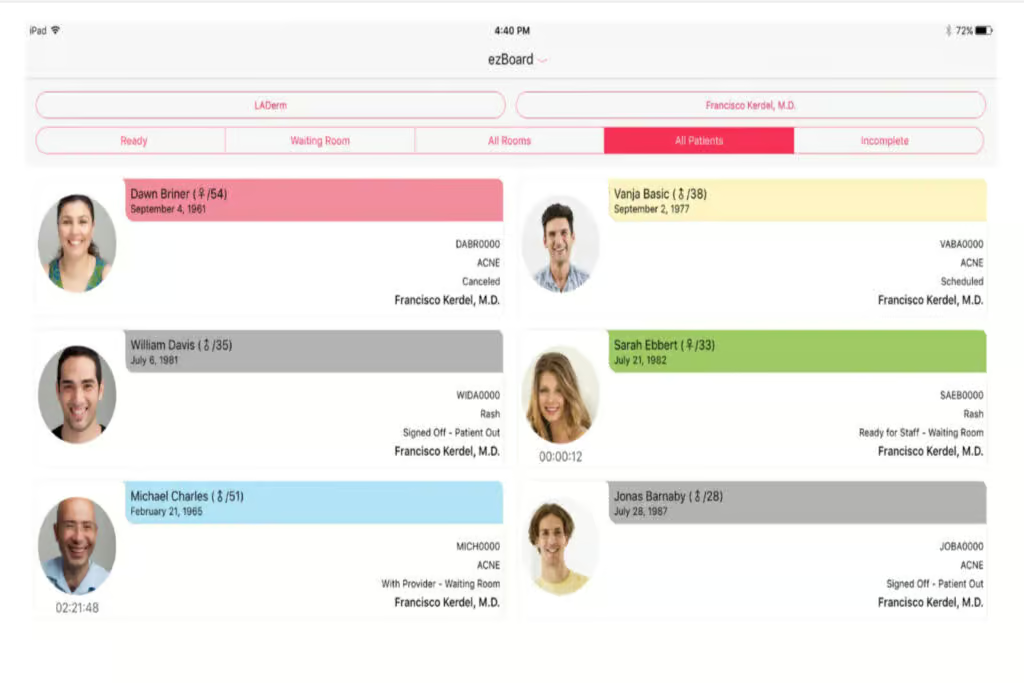
Built exclusively for dermatology, EZDERM is an EMR and practice management solution that supports both medical and cosmetic workflows. It goes deeper into dermatology-specific documentation than general EMRs.
Key Features
- Dermatology EMR: Dermatology-specific documentation with procedure and diagnosis coding.
- Billing: Insurance claim management with built-in dermatology coding support.
- Teledermatology: Built-in telehealth capabilities for remote consultations and follow-ups.
Integrations
EZDERM integrates with major insurance clearinghouses, patient communication tools, and dermatoscopy imaging devices to support end-to-end clinical and front-desk workflows.
Pros
- Built for dermatology workflows.
- Superb dermatoscopy image management.
- Cloud-based access from any device.
- Solid insurance billing with derm-specific codes.
Cons
- Limited built-in marketing tools.
- No AI automation for booking.
- Less suited for cosmetic cash-pay growth.
Good For
Dermatology practices that want a dermatology-specific EMR.
3. CureMD
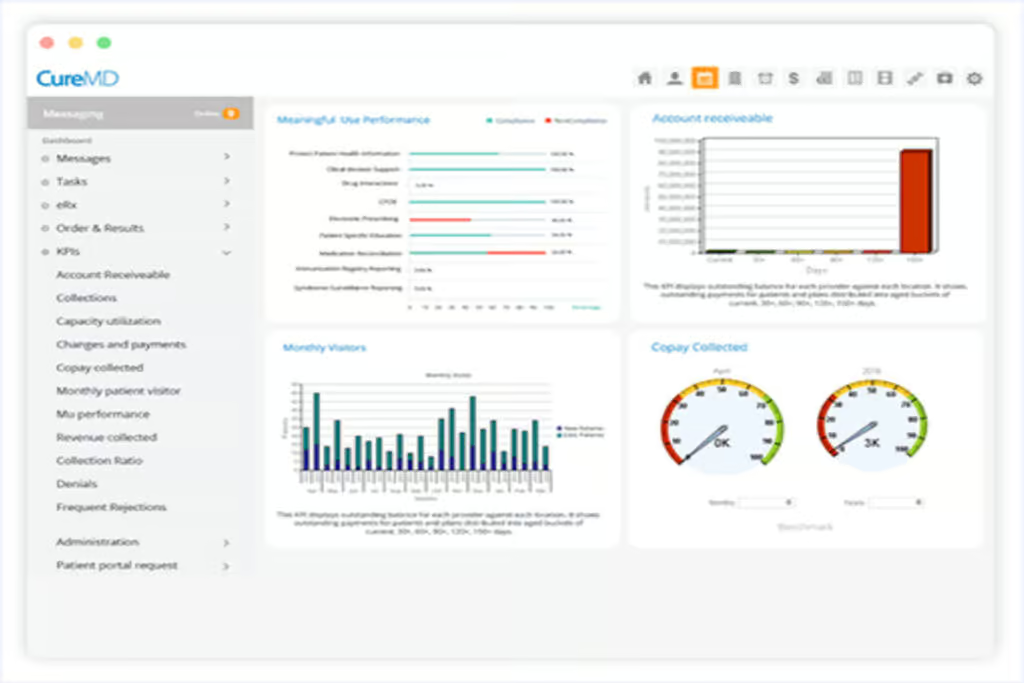
CureMD is an EMR, billing, and practice management platform designed for multi-specialty outpatient practices, including dermatology. It offers customizable clinical templates and a robust revenue cycle management engine. The software also has an analytics dashboard that gives owners real-time visibility into practice performance.
Key Features
- Specialty Workflows: Provides 30+ specialty templates, including dermatology, cardiology, and oncology
- Billing: End-to-end revenue cycle management with claims tracking and denial management.
- Analytics: Real-time dashboards for practice performance, revenue, and patient flow tracking.
Integrations
CureMD connects with major insurance clearinghouses, laboratory information systems, and a patient portal that supports online scheduling, secure messaging, and custom API integrations.
Pros
- Strong RCM tools.
- Customizable templates for multiple specialties.
- Good analytics dashboards.
- Cloud-based with mobile access.
Cons
- No built-in marketing tools.
- Limited aesthetic-specific workflows.
- Implementation can take significant time.
Good For
Multi-specialty dermatology groups that need a strong billing infrastructure.
4. AdvancedMD
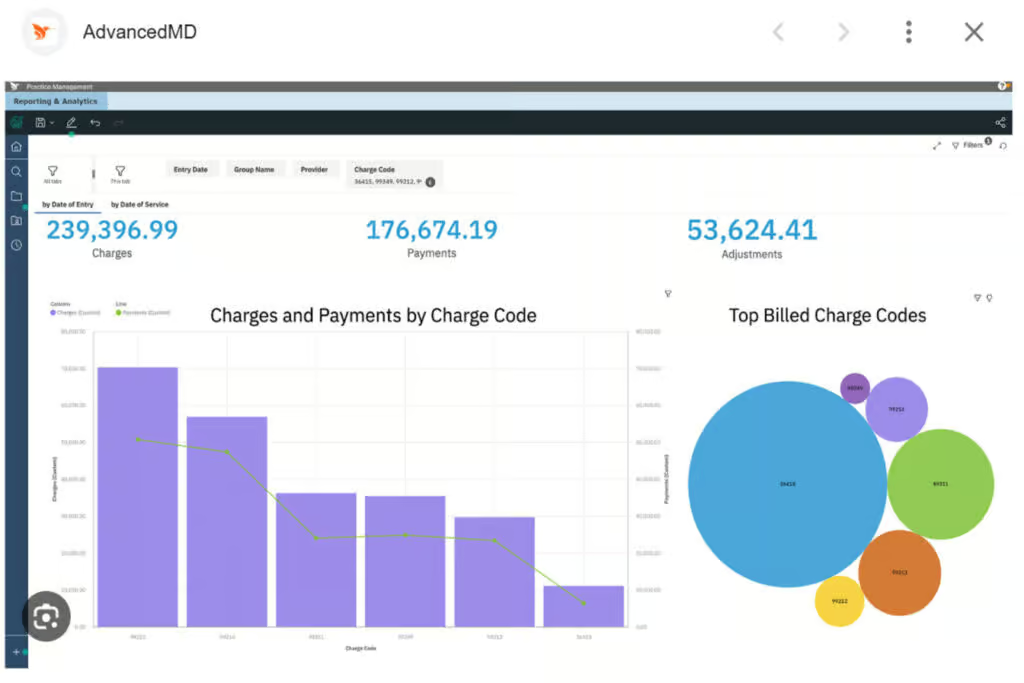
A comprehensive EHR built for multi-specialty care, AdvancedMD is used across a range of practices, including dermatology. It offers strong scheduling tools, a built-in telehealth module, and a reporting engine that gives administrators detailed visibility into operations and revenue.
Key Features
- Dermatology Workflows: Specialty templates and HIPAA-compliant documentation for dermatology workflows.
- Billing: Integrated revenue cycle management with claims tracking and reporting.
- Reporting: Customizable dashboards and financial reporting for practice performance.
Integrations
AdvancedMD integrates with labs, pharmacies, and insurance clearinghouses, and includes a patient engagement suite with reminders, portal access, and telehealth built in.
Pros
- Scheduling and EHR in one system.
- Powerful reporting.
- Telehealth is built in.
- Good for multi-provider dermatology groups.
Cons
- Not purpose-built for cash-pay dermatology.
- Add-on costs can accumulate quickly.
- Steeper learning curve for smaller teams.
Good For
Mid-to-large dermatology practices with multiple providers.
5. Pabau

Pabau is a practice management platform designed for aesthetic clinics, cosmetic practices, and wellness centers. It combines scheduling, EMR, marketing tools, and patient communication in a single interface at a lower cost of entry than enterprise platforms.
Key Features
- CRM: Lead capture, patient profiles, and automated follow-up sequences for effective, targeted patient engagement.
- Scheduling: Drag-and-drop calendar with multi-provider and multi-location support.
- Marketing Tools: Email and SMS campaigns, recall reminders, and online booking integration.
Integrations
Pabau connects with payment processors, accounting tools, and third-party booking widgets, with API access available for custom workflow integrations.
Pros
- Low starting price point.
- CRM and scheduling in one system.
- Good for small aesthetic clinics.
- Online booking with patient portal.
Cons
- Limited clinical dermatology depth.
- No AI automation for lead conversion.
- Less robust reporting than enterprise options.
Good For
Small aesthetic clinics and cosmetic practices need an affordable solution.
6. DrChrono
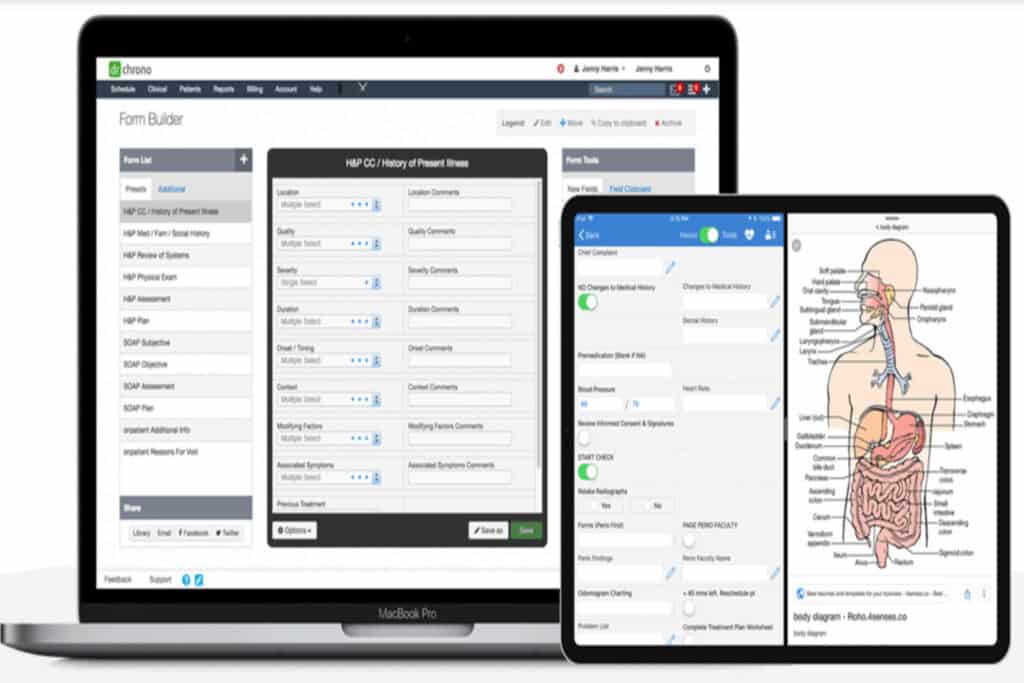
For insurance-heavy dermatology practices, DrChrono is a fully cloud-based EHR and revenue cycle management platform with strong billing capabilities and a free, open API. It offers customizable templates, connected billing and charting, and mobile access that help dermatology teams manage insurance and payments in one system.
Key Features
- Cloud EHR: Browser-based access with specialty templates and mobile app support.
- RCM: Integrated billing with AI claims checker, CPT, and ICD-10 code library.
- Free API: Open API with no call limits for custom integrations and workflow automation.
Integrations
DrChrono integrates with 40+ partners, including labs, payment processors, and scheduling tools, with its open API enabling custom connections to CRMs and marketing platforms.
Pros
- Insurance billing and claim management.
- Open API with no usage limits.
- Cloud-based with mobile access.
- AI claims error detection reduces rejections.
Cons
- No built-in marketing or 2-way SMS tools.
- Support response times of 3-5 business days.
- Per-provider pricing becomes expensive for groups.
Good For
Insurance-focused dermatology practices with a high volume of claims.
7. eClinicalWorks
eClinicalWorks is one of the most widely used EHR and practice management platforms in the US. It offers population health management, AI-assisted documentation, telehealth, and integrated billing.
Key Features
- Population Health: AI-assisted documentation with population health management tools.
- Billing: Integrated revenue cycle with denial management and multi-payer support.
- AI Tools: HEDIS and quality measure tracking, AI documentation assistance, and analytics.
Integrations
eClinicalWorks integrates with pharmacies, labs, insurance clearinghouses, and a wide range of health information exchanges, with patient-facing tools for portal access and telehealth.
Pros
- Enterprise-grade infrastructure.
- Strong population health management tools.
- AI documentation reduces charting time.
- Broad integration with health information exchanges.
Cons
- Complex setup and steep learning curve.
- Not designed for aesthetic or cosmetic workflows.
- Limited patient acquisition tools.
Good For
Large multi-provider dermatology groups with complex billing needs.
8. athenaOne
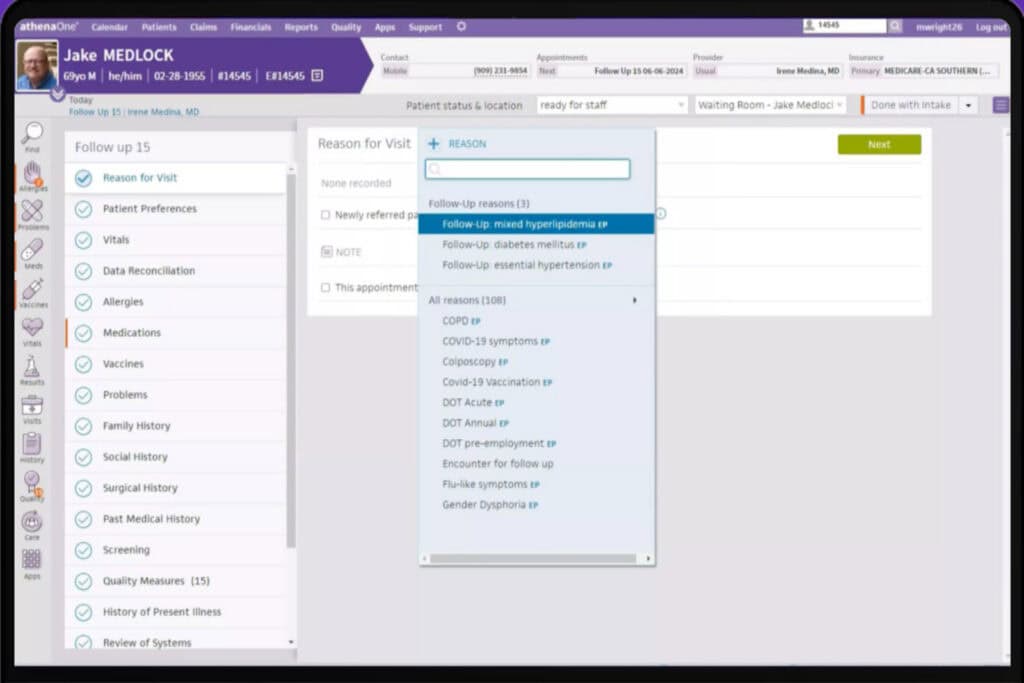
Known for its managed billing services and powerful network-based benchmarks, athenaOne is a highly respected EHR platform. It suits practices that want to hand off billing complexity to a managed service.
Key Features
- Cloud EHR: Specialty-configurable documentation with mobile app support for easy access.
- Revenue Cycle: Managed billing services with network benchmarking and claim follow-up.
- Patient Engagement: Automated reminders, portal messaging, and online scheduling.
Integrations
athenaOne integrates with labs, imaging systems, insurance clearinghouses, and a broad range of health system partners through the athenahealth network,elehealth, and third-party engagement tools are also supported.
Pros
- Top-tier managed billing.
- Network-powered benchmarking.
- Strong cloud-based EHR with mobile access.
- Solid patient portal.
Cons
- Not built for cosmetic workflows.
- No marketing automation.
- Opaque pricing.
Good For
Growing dermatology practices that want to outsource billing complexity.
9. Nextech
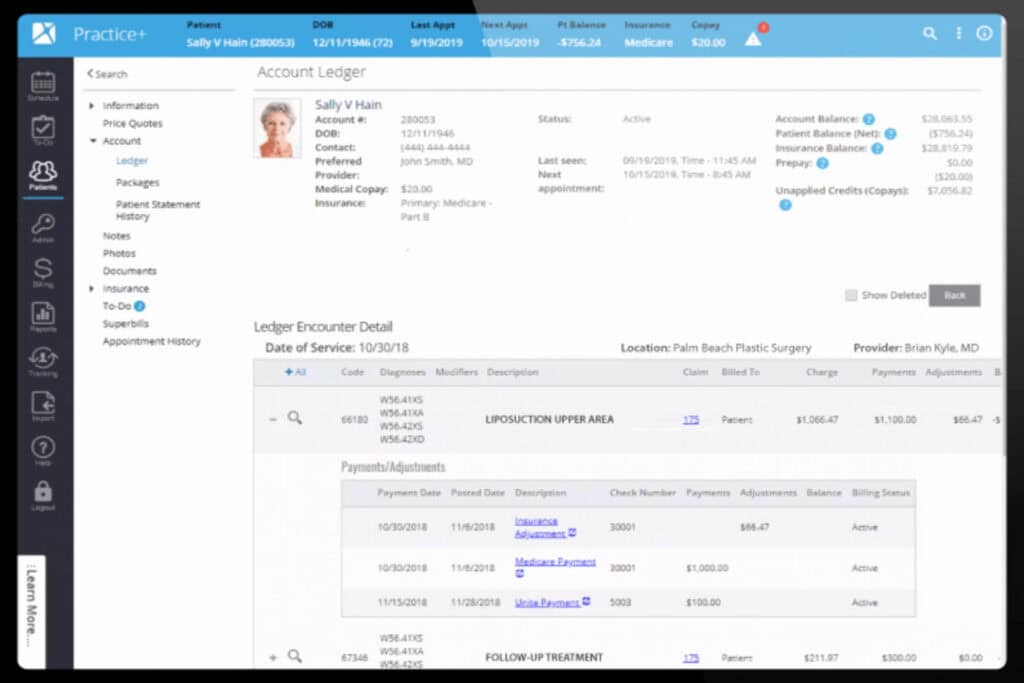
Originally built for ophthalmology and insurance-based specialties, Nextech is a specialty EHR and practice management platform. Its enterprise-level features suit high-volume practices, but its aesthetic workflows are still maturing.
Key Features
- Clinical EHR: Deep specialty documentation with an AI scribe for faster charting.
- Scheduling: Multi-provider scheduling with resource management and surgical workflow support.
- Revenue Cycle: Integrated billing with enterprise fee schedules and multi-location reporting.
Integrations
Nextech integrates with TouchMD for photo management, major insurance clearinghouses, a white-labeled CRM, labs, and pharmacies, with API access for custom connections.
Pros
- Deep clinical EHR for dermatology workflows.
- AI scribe and photo assist are now available.
- Enterprise-level multi-location controls.
- Strong specialty RCM infrastructure.
Cons
- High per-provider cost.
- Originally built for ophthalmology, not aesthetics.
- Weaker marketing tools.
Good For
High-volume plastic surgery and dermatology practices with multiple providers.
10. ModMed (Modernizing Medicine)
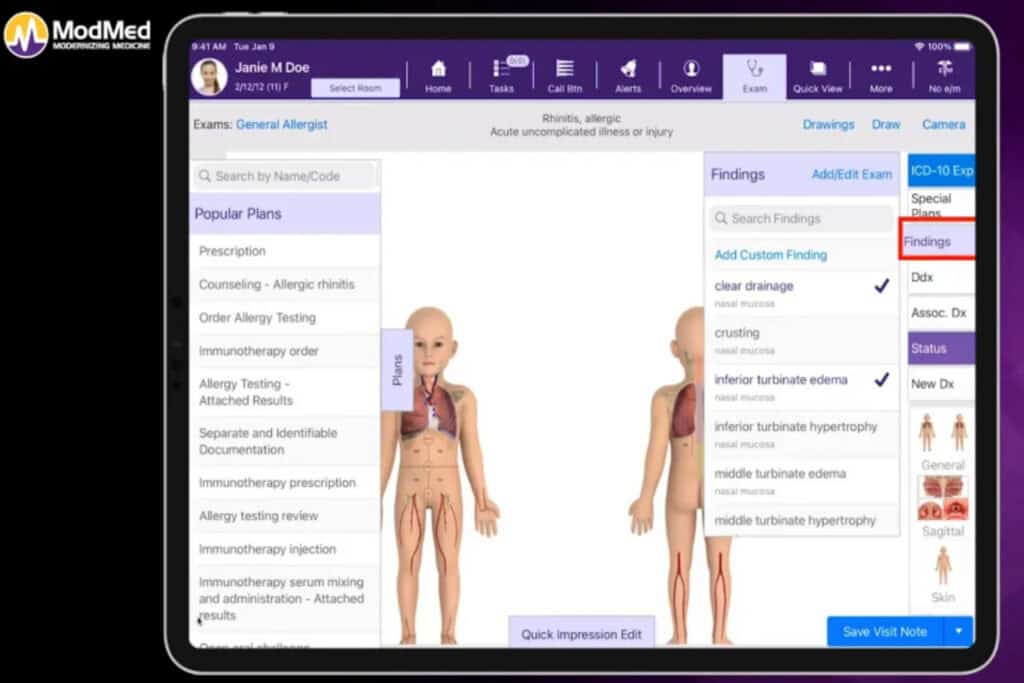
Modernizing Medicine, known as ModMed, offers a dermatology-specific EHR called EMA Dermatology, designed around how dermatologists think and document. It is a strong clinical tool with solid analytics and billing.
Key Features
- Specialty EHR: Adaptive learning EHR with dermatology-specific documentation templates.
- Analytics: Practice performance dashboards with clinical and financial reporting.
- Billing: Integrated practice management with claim tracking and billing support.
Integrations
ModMed integrates with labs, pharmacies, imaging tools, and a patient portal that supports online scheduling, secure messaging, and some third-party marketing platforms.
Pros
- Dermatology-specific documentation.
- Good analytics and reporting.
- User-friendly.
- Good billing and RCM infrastructure.
Cons
- Limited built-in marketing.
- No pricing transparency.
- Not designed for cosmetic cash-pay growth.
How do you choose the best dermatology practice management software?
Selecting the right platform is a decision that affects your entire practice. Here are five criteria worth evaluating carefully:
1. Clinical Depth Matched to Your Service Mix
If your practice blends medical dermatology with cosmetic services, confirm the platform supports both insurance and cash-pay billing, photo management, and aesthetic-specific documentation. Avoid retrofitted general EMR templates.
2. Marketing and Patient Acquisition Capabilities
In a competitive market, built-in lead capture, automated follow-up, reputation management, and social posting are as important as clinical tools. Evaluate whether these are native features or costly add-ons for your chosen platform.
3. Automation That Reduces Manual Work
A platform with AI-based booking, automated recall campaigns, and inventory management meaningfully reduces the administrative burden. The difference between built-in automation and requiring manual staff intervention at every step adds up fast.
4. Scalability as Your Practice Grow s
Evaluate whether the platform supports multi-location expansion and increased provider count without requiring a costly migration. Outgrowing your software is a real and expensive problem.
5. Total Cost of Ownership, Including Add-Ons
Factor in add-on costs for marketing tools, SMS, telehealth, and photo management. A lower base price with significant add-ons often exceeds the total cost of a bundled solution like PatientNow. So, dig deep to get the real, total cost.
The Best Dermatology Practice Management Software Won't Feel Like Software
Every tool on this list has genuine strengths and comes with trade-offs worth examining before you commit. But if your dermatology practice blends medical and cosmetic services, you need more than basic charting and billing. You need hybrid insurance and cash-pay workflows, advanced photo documentation, automated patient follow-up, and reporting that protects margins.
PatientNow brings clinical-grade EMR, built-in marketing, AI-driven automation, photo management, payments, and KPI dashboards together in one unified system. This removes the need for multiple vendors and disconnected tools. It’s designed to support both providers in the treatment room and owners tracking growth.
Ready to see how PatientNow works for your practice? Book a demo today and let our team show you what modern dermatology and aesthetic practice management look like when everything works together.
Frequently Asked Questions About Dermatology Practice Software
Let’s go over some questions you may still have.
1. What is the best practice management software for dermatology?
PatientNow is the top choice for practices that offer cosmetic services alongside clinical care. It combines a clinical-grade EMR, built-in marketing automation, AI-driven booking, and revenue tools in one platform. For strictly insurance-based dermatology, EZDERM and ModMed offer strong specialty-specific documentation.
2. Do dermatology practices need a specialty EMR or can they use a general one?
Dermatoscopy documentation, cosmetic charting, injection tracking, and before-and-after photo management are difficult to replicate in general EMRs, which typically require significant customization and still leave gaps. But a purpose-built platform reduces compliance risk and saves setup time.
3. How much does dermatology practice management software cost?
Entry-level tools with basic features like Pabau start around $23/month. While PatientNow Essentials starts at $410/month, and enterprise solutions like Nextech often exceed $1,000/month per provider. So. always compare total annual costs, including add-ons, not just base monthly rates.
4. Can dermatology practice management software handle both insurance and cash-pay billing?
Yes. But not equally well. Many general EMRs focus on insurance workflows and make cash-pay cosmetic billing cumbersome. While some aesthetic platforms lack insurance billing altogether. But PatientNow supports both, allowing practices to manage medical dermatology claims, cash-pay services, memberships, and integrated payments in one system, without switching between separate tools.
5. Can dermatology practice management software help with patient retention?
Yes. PatientNow users have seen Botox retention rates climb from 50% to 70-80%. Retention improves when follow-up is automated rather than left to manual staff effort.
Explore this post
Book a demo to see PatientNow in action