Quick summary
AI takes three jobs off a wellness center's admin load today. It drafts visit notes from the provider's conversation with the patient, answers plain-English questions about the practice's numbers, and handles routine calls, texts, and website chats. A person stays in charge of each one: providers review and sign every AI-drafted note, and staff and owners act on what the AI surfaces.
Where a wellness center's hours go
Clinical paperwork takes a measurable share of the working day. In a 2016 time-and-motion study published in the Annals of Internal Medicine, 57 U.S. physicians in family medicine, internal medicine, cardiology, and orthopedics spent 49.2% of their office day on EHR and desk work and 27.0% in direct face time with patients. The 21 physicians who also kept after-hours diaries reported another 1 to 2 hours of work each night, mostly in the EHR. The study did not include wellness or aesthetics practices, so read it as a benchmark for clinical paperwork in general.
A lean wellness practice carries that load on a few people. There is a provider seeing patients back to back, a front desk juggling calls and check-ins, and often an owner who is also a clinician, doing injections in the morning and the P&L at night. When one person wears that many hats, inefficiency spreads across the whole week. Slow charting follows the provider home. When nobody has time to build a report, decisions get made on instinct. By Friday, those small delays have added up to hours.
Which three jobs is AI ready to take on
Three admin jobs in a wellness center are concrete enough to hand to AI today:
- Clinical documentation: Turning a provider-patient conversation into a structured chart note, so the provider is not typing it up after hours.
- Reporting: Answering plain-English questions about the practice's numbers, so nobody has to export data or build a report first.
- Front-desk communication: Answering calls, texts, and website chats as they arrive, so staff are not pulled away every time the phone rings.
Each job still has a person reviewing the output before it becomes final. The provider signs the note, the owner decides what to do with the answer, and staff step in whenever a conversation needs them.
What AI looks like inside a wellness center
PatientNow brings EMR, scheduling, payments, marketing, photo documentation, and AI automation into one connected platform built for aesthetics and wellness. Their AI tools map directly to the three jobs.
Charting: AI Scribe drafts the note, and the provider signs it.
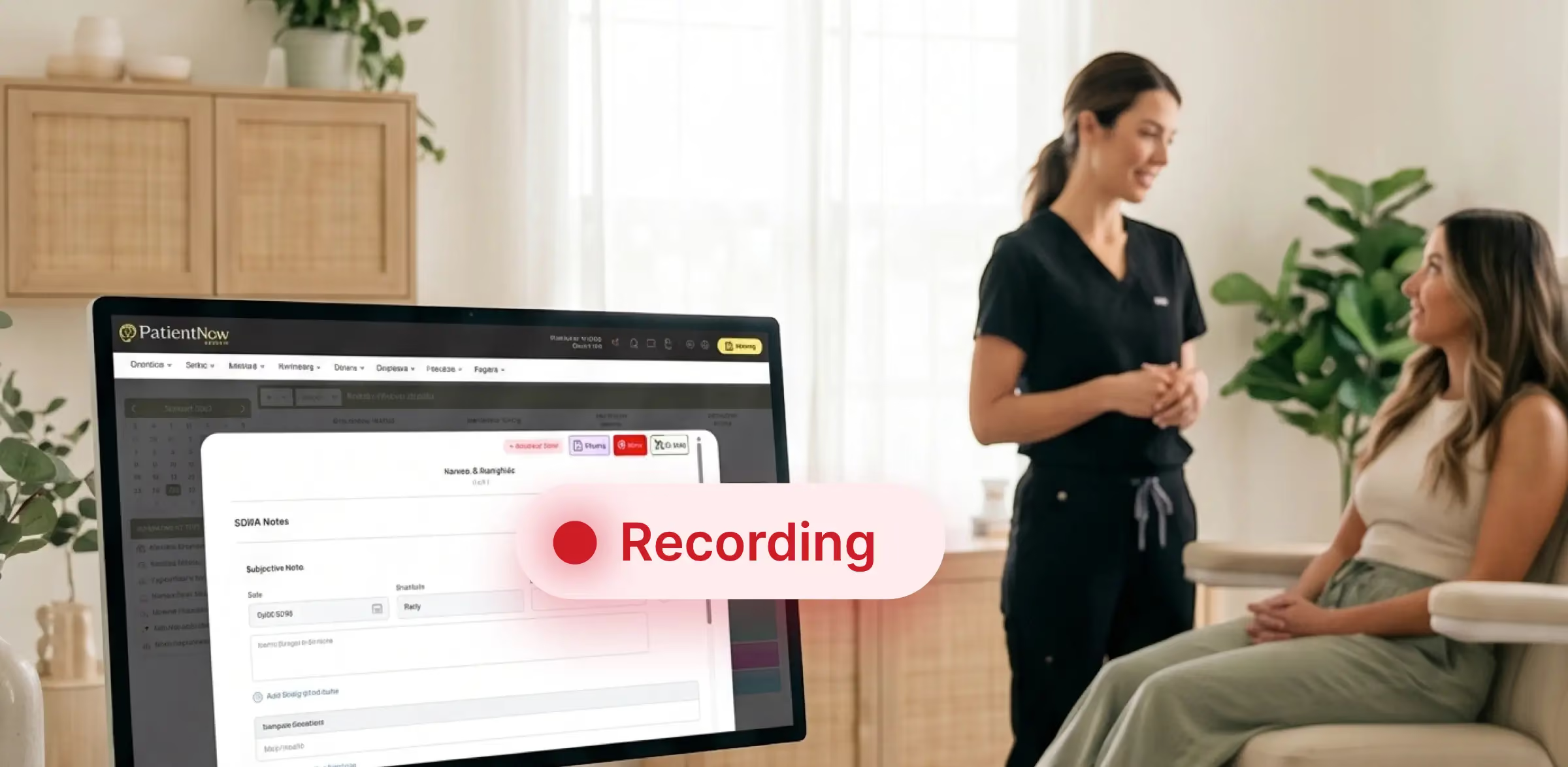
Documentation is usually the first task to spill into a provider's evening, because the schedule is already full of patients. AI Scribe, built into PatientNow's EMR, turns provider-patient conversations into structured, editable SOAP notes. It captures details through ambient listening or dictation while the provider stays focused on the patient.
The workflow change happens in the treatment room. The provider talks through the visit, AI Scribe drafts the SOAP note in the background, and the provider reviews, edits, and signs the draft before it files to the patient timeline. Nothing is finalized without that review.
PatientNow says providers can save up to 25% of the time normally spent documenting patient visits (AI Scribe release, May 29, 2026). AI Scribe runs inside PatientNow, with no extra logins, browser extensions, or third-party platforms. The signed note sits in the same timeline as the patient's visit history, photos, and forms. AI Scribe is included on every PatientNow plan at no additional cost. For what to test before choosing any AI scribe, see An AI scribe that lives inside the EMR.
Front desk: Recura AI takes the routine calls and chats.
Front-desk load is a different drain: a steady run of small interruptions that pull staff away from the patient standing at the desk. Recura AI is PatientNow's AI front desk. It handles routine requests quietly in the background. Its AI Receptionist picks up calls and texts, handles common questions using your practice info, and schedules the appointment or routes to staff when needed. Its AI Webchat Coordinator answers website visitors' questions about treatments and policies, including after hours.
The practice chooses when the AI picks up: only when no one answers after a few rings, after hours, or on every call. Bookings sync directly with the PatientNow calendar, so there is no second system to reconcile. Recura AI is an add-on available on any PatientNow plan, and your quote confirms what is included.
Reporting: Insights Hub answers questions about the numbers.
The third drain sits with the owner: not knowing the numbers until someone builds a report. Insights Hub is PatientNow's practice analytics solution. It works in two layers.
- The KPI Dashboard holds the practice's reporting in one place, with revenue, scheduling, provider, and performance metrics in one connected dashboard. Any KPI breaks down by location, provider, service line, or timeline.
- AI Analytics adds predictive insights and an AI Business Analyst. The owner types a plain-English question, such as "What's my highest-margin service?" or "Compare my revenue to last year," and gets an instant answer, exportable data, and clear next steps.
The predictive layer looks forward. AI Analytics forecasts revenue dips, no-shows, churn, membership risk, and inventory needs early enough to plan ahead. For a wellness center built on memberships and repeat programs, that means seeing a soft month or a member drifting away while there is still time to act.
On PatientNow's pricing page, AI-powered business insights and analytics are part of the Catalyst AI plan, and AI Analytics also appears in the list of optional add-ons. For more on getting answers without spreadsheet exports, see Stop building patient lists in Excel.
Does inventory management need AI?
Not every time saver in a wellness center is AI, and inventory shows the difference. In PatientNow, every sale and service automatically updates stock counts, and low-stock alerts flag the team to restock before supplies run out. That is rule-based automation, with no prediction or learning involved. For practices that restock peptides, injectables, or supplements on a regular cycle, it still takes manual tracking off the team.
Forecasting is the AI part. AI Analytics predicts inventory needs alongside revenue and demand, which helps when a busy season is coming and stock has to be set before the rush.
Why this matters for a wellness practice
The payoff is capacity. When AI Scribe drafts the note during the visit, the provider can finish charting before leaving the treatment room and keep the evening. An owner who wants to know which service has the highest margin can ask and get an answer in seconds. With routine questions handled, the front desk can stay present with the patients at the desk. For a lean team, the aim is time back without a new hire for paperwork.
How PatientNow connects the three jobs
Operational drag in a wellness center builds from small tasks: notes finished after hours, the same questions answered all day, and reports pulled at night. Start with the task that costs your team the most hours, then add the next one.
PatientNow runs these jobs on one patient record. A booking made through Recura AI lands on the PatientNow calendar, the provider charts the visit with AI Scribe, and the visit and payment data feed the KPI Dashboard in Insights Hub. No one re-enters the same information in a second system.
Choose PatientNow if your wellness center wants documentation, front-desk, and reporting AI working from the same patient record, with providers and staff reviewing what the AI produces. Book a demo to see it with your own workflows.
Frequently asked questions
What still needs a person when a wellness center uses AI?
A person still owns clinical sign-off and business decisions. In PatientNow, the provider reviews, edits, and signs every AI Scribe draft before it files to the chart. Recura AI books the appointment or routes the conversation to staff when needed, and the practice chooses when the AI picks up the phone. AI Analytics flags a revenue dip or a churn risk, and the owner decides what to do about it.
Can AI warn a wellness center about membership churn?
Yes. PatientNow's AI Analytics forecasts churn and membership risk alongside revenue dips and no-shows, early enough to plan ahead. For a wellness center that runs on memberships and repeat programs, that gives the team time to reach a member before a cancellation shows up in the numbers.
Explore this post
Book a demo to see PatientNow in action