Table of Contents
Dermatology Patient Lifetime Value: What It Is, Why It Matters, How to Increase
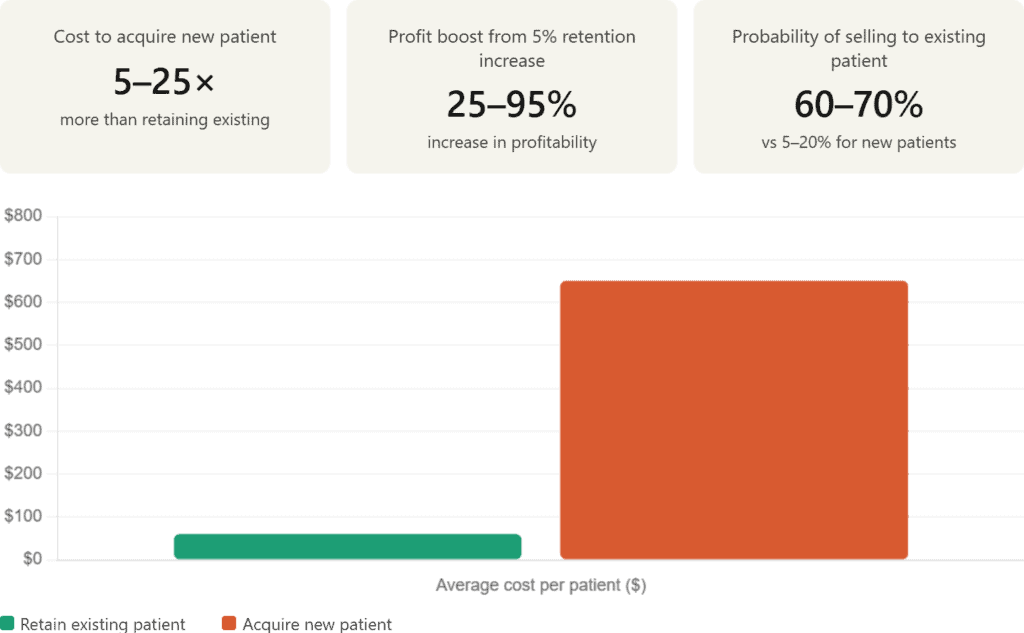
Most dermatology clinics focus heavily on getting new patients, even though keeping existing ones is far more valuable. A new patient can cost 5 to 25 times more to acquire, while increasing retention by just 5% can raise profits by 25% to 95%. Practices also have a much higher chance of selling to current patients (about 60–70%) compared to new ones (5–20%).
Despite this, many clinics don’t track Patient Lifetime Value (PLTV), which is the total revenue a patient brings over time. The main idea is to shift from one-time visits to building long-term patient relationships and “lifetime experiences” that drive repeat care. This article explains what PLTV is, why it matters more than any single new patient campaign, and how to increase it.
What Is Dermatology Patient Lifetime Value (PLTV)?
Patient Lifetime Value (PLTV) is the total revenue a patient brings to a dermatology clinic over the full length of their relationship. This includes repeat visits, procedures, and skincare products. But it should be seen as building a long-term relationship, not just making money from each visit. For instance, some clinics, like Luminescence Medical Esthetics, start with a free consultation to understand what patients really need. They aim to under-promise and over-deliver, focusing on trust and long-term care rather than quick sales.
PLTV also isn’t one-size-fits-all, so medical and cosmetic patients are often measured separately because they behave differently. Medical patients may come in for yearly skin checks or occasional treatments. While cosmetic patients may return regularly for injectables, lasers, and products. Over several years, even an average patient can generate steady, repeated revenue, but many practices don’t fully track or optimize this long-term value.
Why PLTV Matters for Your Dermatology Practice
PLTV matters for your dermatology practices for the following reasons:
- It’s Your Real Growth Engine
Many dermatology practices focus more on bringing in new patients instead of taking care of the ones they already have. In reality, long-term growth comes from ongoing relationships and full treatment planning, not just the newest device or campaign.
- It Makes Your Marketing Spend Smarter
PLTV helps you understand how much you can safely spend to acquire a patient and sets a benchmark for marketing efficiency. A common goal is a 3:1 LTV to customer acquisition cost ratio. So, the value of a patient should be at least three times what it costs to bring them in. This turns marketing from guesswork into a clearer investment decision.
- Retail Is a Massive, Overlooked PLTV Driver
Retail skincare is often underused, even though it can significantly increase overall patient value. Many practices only earn 2–5% of revenue from retail, while a stronger benchmark is closer to 15–20%. When patients understand that home care supports their in-clinic results, they’re more likely to stay consistent, especially when education is done well.
- It Increases Practice Valuation
PLTV is also important when it comes to how much a practice is worth. Buyers look closely at retention and reputation because they reflect future cash flow. A loyal patient base makes a clinic far more attractive than one that constantly relies on new patients.
- The Cost of Losing a Patient Is Enormous
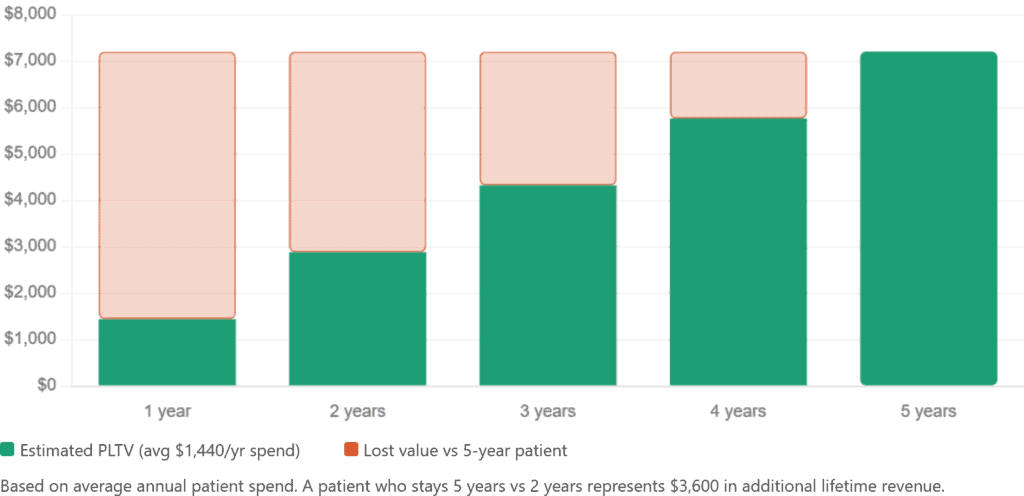
Even small drops in retention add up. If a patient relationship shortens from 5 years to 2 years, that’s about $3,600 in lost value per patient. Across a patient base, that loss becomes huge but is largely preventable with better retention.
How to Calculate PLTV for Dermatology Practices
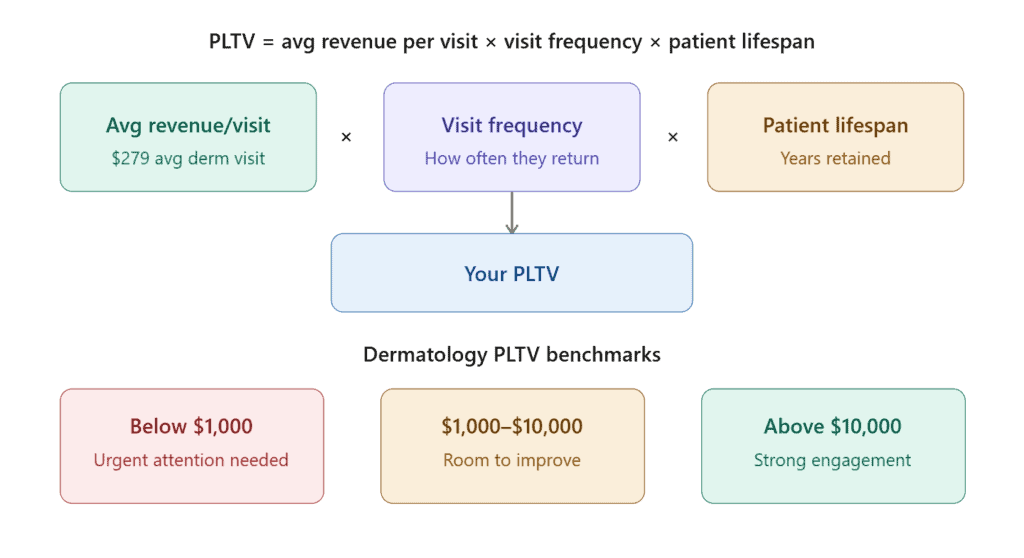
Calculating PLTV is actually simple and doesn’t need special software. It’s based on three important numbers:
- How long does a patient stay with your clinic?
- How often they return (recall rate).
- How much profit do you make per visit?
When you multiply these together, you get Patient Lifetime Value. But the challenge is using real data instead of guesses. The main inputs are straightforward. So, here’s how you can go about calculating PLTV for your dermatology practice:
- Average revenue per visit varies depending on the service, like a skin check versus a laser treatment or Botox session.
- Visit frequency, which is how often patients actually come back compared to what was planned. For example, someone scheduled for Botox every 3 months but coming every 6 months cuts their value in half.
- Patient lifespan, or how many years a patient typically stays with your practice, is often underestimated because patients don’t always formally “leave.”
For context, the average dermatology visit brings in about $200-$300. But a new patient might generate around $500 on their first visit and $1,000–$1,500 in the first year. A strong PLTV is usually above $10,000, while anything under $1,000 suggests poor retention or engagement.
This becomes even more important for practices using energy-based devices, since these systems often cost between $75,000 and $180,000, with some exceeding $200,000. These devices can be very profitable, but only if there are enough returning patients to support ongoing treatments.
For example, instead of buying everything up front, Dr. Swers, the owner of Luminescence Medical Esthetics, Columbia, PA, built his device portfolio over time. He started with a V20 package, then added Primae and Enerjet after about a year, and later expanded with Elysian and ImagePro as patient demand grew. This shows how device ROI functions best when it’s based on your existing patient volume, not expected growth.
But the mistake many clinics make is buying equipment based on expected new patients instead of the patients they already have. If a device needs 15 treatments a month just to break even, it becomes a risk without strong retention.
Besides, many practices calculate PLTV incorrectly. They ignore patient drop-off, treat all patients the same instead of segmenting them, or focus on revenue instead of actual profit. This can make PLTV look higher than it really is. For example, a cosmetic patient may bring in $3,000 a year. But once you factor in staff time and treatment costs, the real profit can be much lower than expected.
How to Increase and Maximize PLTV
Once you understand how to evaluate PLTV, the next step is to actively increase it through better systems, stronger patient relationships, and consistent follow-through. The section below shares realistic ways to do that in your day-to-day practice:
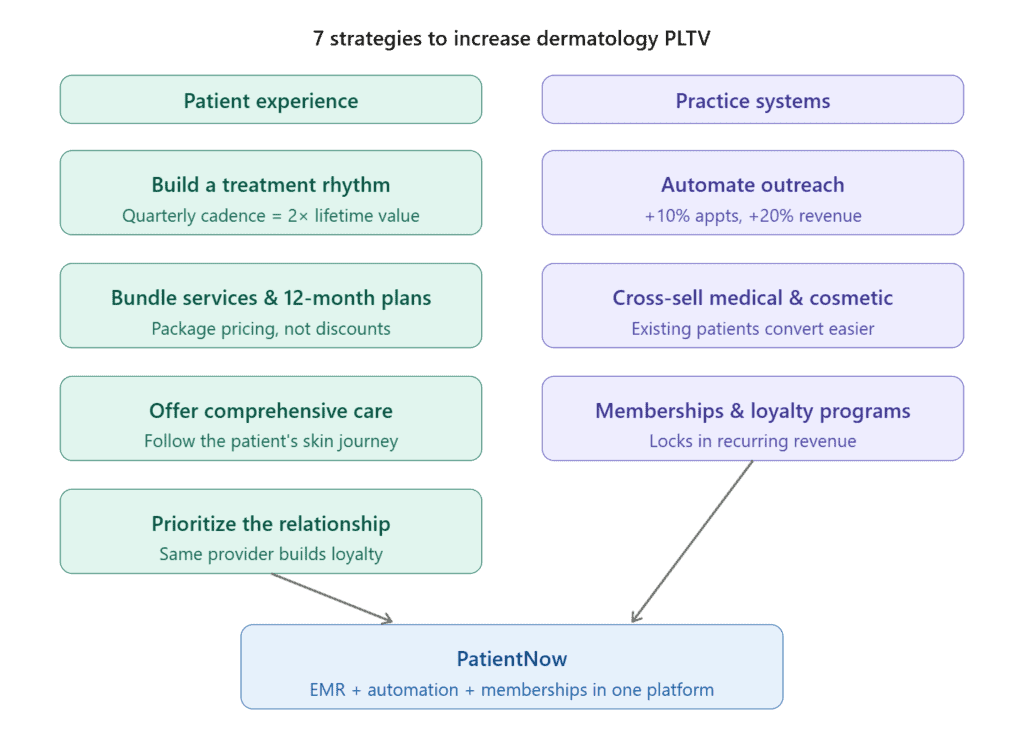
- Build a Treatment Rhythm and Protect It
Every patient has a natural treatment schedule, like Botox every three to four months or regular seasonal services. Staying on that schedule is important for steady revenue. When patients stick to it, their value adds up quickly, like someone coming in every three months can be worth nearly twice as much as someone who delays visits to every six months.
But the challenge is keeping everyone on track without relying on staff to manage it manually. Here, PatientNow can help by sending automated, personalized reminders and follow-ups. This makes certain that patients stay consistent with their treatments without extra effort from the team. It’s an all-in-one system made for med spas and aesthetic clinics, combining scheduling, EMR, marketing, and patient communication in one place. So, you don’t have to manage multiple tools.
- Shift from Manual to Automated Outreach
Manual follow-ups are one of the biggest hidden losses in patient lifetime value for dermatology practices. When staff spend time calling and chasing patients, they have less time to focus on patients who are already in the clinic. Closing these timing gaps can increase appointments and revenue. Automation helps solve this by freeing staff to focus on in-person care and stronger patient relationships.
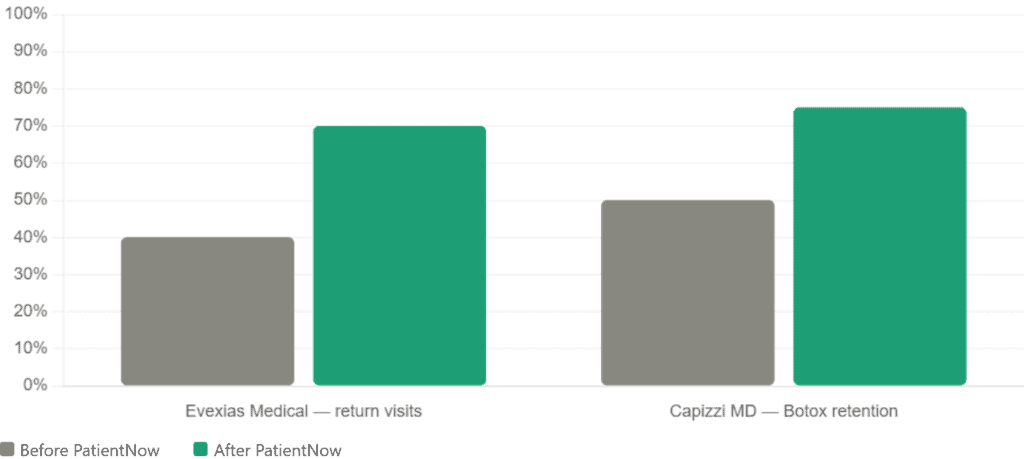
PatientNow’s Recura AI automates booking, lead follow-ups, cancellations, rescheduling, and patient reminders so patients remain engaged, and nothing gets missed. Real results back this up as well. Evexias Medical Centers increased return visits from 40% to 70%, and Dr. Peter Capizzi saw Botox retention rise from 50% to 70–80%.
- Bundle Services and Create 12-Month Treatment Plans
One of the most effective approaches highlighted is treating every consultation as the start of a long-term plan, not a one-time decision. When patients are shown a clear 12-month treatment roadmap, they understand the full picture and are more comfortable investing in their care over time. This also improves clinical outcomes, since consistent treatment usually leads to better results, higher satisfaction, and more referrals.
A good real-world example of this is laser hair removal. Instead of selling single sessions, Dr. Swers offers an 8-session package at a 20% “special package price.” Patients are told upfront that results vary and may take 4, 6, or even 10 sessions, depending on hair growth cycles. They are also educated that only about 40% of hair is in the active growth phase at one time, which is why treatments every 4–6 weeks are needed. If sessions are left over, they can be used for other treatments, which keeps value in the package while supporting continuity of care.
PatientNow supports this approach with treatment pathways, automated follow-ups, and personalized communication based on patient interests. This makes it easier for practices to build and manage structured long-term plans from the very first visit.
- Cross-Sell Between Medical and Cosmetic
A patient who comes in for a skin check is already part of your practice, and often just one conversation away from cosmetic treatments. It’s usually much easier and cheaper to convert existing patients than to attract new ones for the same services. For example, someone getting Botox may also benefit from filler, skincare products, or other treatments they haven’t tried yet.
But you must know each patient’s history and what they haven’t tried yet. PatientNow helps with this by giving providers and front desk teams clear data and dashboards. So, they can see gaps in care and start the right conversations at the right time.
- Offer Comprehensive Care to Remove Drift
Patients don’t stay in one static condition, and if a clinic doesn’t stay connected through those changes, they lose them. Skin needs evolve over time, as acne in the teens can continue into adulthood, sun damage builds up, and hormonal shifts can create new concerns.
When a clinic supports patients through the full journey, they’re less likely to switch providers each time something changes. This kind of ongoing care isn’t just better medicine, but it also improves retention. PatientNow helps practices stay in touch through treatment pathways and automated follow-ups, so patients are guided and reminded to return instead of slipping away.
- Prioritize the Patient Relationship Over the Transaction
Patient retention is mostly about relationships, not just software. Patients connect with their provider, not the clinic, so if they see a different provider each visit, they’re less likely to stay loyal. Consistent care is just as important as the quality of care.
For instance, Dr. Swers follows a simple but important principle. He will say no to treatments he doesn’t believe in, even if it means losing a sale. Whether it’s overfilling a face or doing overly bright dental veneers, he avoids it if it doesn’t look natural. As he puts it, patients who feel overdone are not the kind who bring long-term referrals. His focus is on building trust so patients stay for years, not just one visit.
Consistent care also helps operationally to schedule follow-up visits during the first appointment, which supports both better clinical outcomes and steady revenue. PatientNow helps support this relationship-building with tools like two-way SMS, a patient mobile app, and automated follow-ups after visits. These features retain communication between appointments so patients feel supported and connected, not just reminded to return.
- Use Membership and Loyalty Programs for Recurring Revenue
Memberships help increase patient lifetime value by turning one-time patients into repeat, ongoing patients. Subscription-based care also makes revenue more predictable and reduces reliance on constantly bringing in new patients. This helps smooth out monthly ups and downs.
PatientNow supports this with built-in memberships and loyalty programs, and integrated payments, patient financing, and next-day funding. This makes it easier for patients to move forward with treatment instead of delaying due to cost. For practices like Georgia Plastics under Dr. Stanley Okoro, PatientNow has supported strong growth, including more than doubling revenue over seven years.
Turn Every Patient Into Long-Term Growth
Patient Lifetime Value (PLTV) helps you understand how your dermatology practice really grows. Instead of focusing only on new patients, it shows the importance of keeping existing patients engaged and coming back over time. PLTV improves retention, makes marketing more effective, and increases the entire revenue.
But increasing PLTV doesn’t require big changes. It’s about staying connected with patients, keeping them on a regular treatment schedule, and making follow-ups easy. PatientNow helps with this by combining scheduling, EMR, marketing, and automation in one place, so you can build long-term plans and keep patients returning without extra work.
If you want steady, predictable growth, start by getting more value from the patients you already have. PatientNow can help you do that. So, book a demo to see how it delivers on its promise!