
Table of Contents
Your Schedule Is Either Your Biggest Asset or Your Biggest Leak
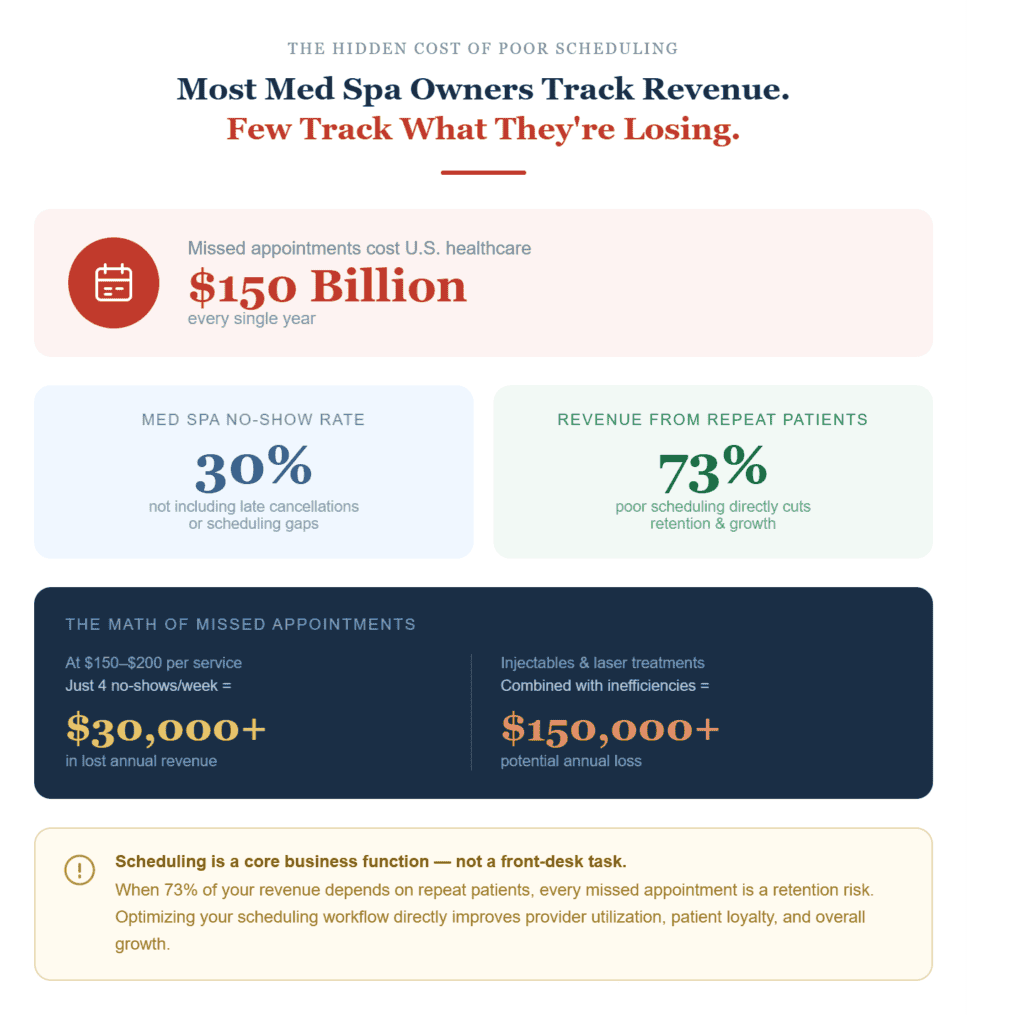
Most med spa owners closely track revenue, and few track the money they lose from missed appointments. In the U.S., missed appointments cost healthcare systems an estimated $150 billion each year. No-show rates in med spas specifically can be as high as 30%, not including late cancellations, scheduling gaps, or inefficient bookings that leave empty time between treatments.
Even at a modest $150–$200 per service, just four no-shows a week can add up to more than $30,000 in lost annual revenue. While higher-value treatments like injectables or lasers can increase losses to $100,000–$150,000 or more when combined with other inefficiencies.
Despite this, scheduling is often treated as a front-desk task instead of a core business function. Since most med spa revenue comes from 73% of repeat patients, poor scheduling directly affects retention, provider utilization, and overall growth. This guide explains how to improve patient scheduling workflow at your medical spa, with clear metrics to measure success.
Audit Your Workflow Before You Optimize Anything
Before training staff or adding new tools, you need to understand where your schedule is breaking. Many owners skip this step and try to fix what they think is wrong. But scheduling problems are often misleading. No-shows may come from weak confirmations, low utilization from poor timing, and overbooked days from missed rebooking earlier. The right solution only becomes clear when you look at the full system, not just one issue. Here’s how to audit your med spa workflow:
Map Every Touchpoint
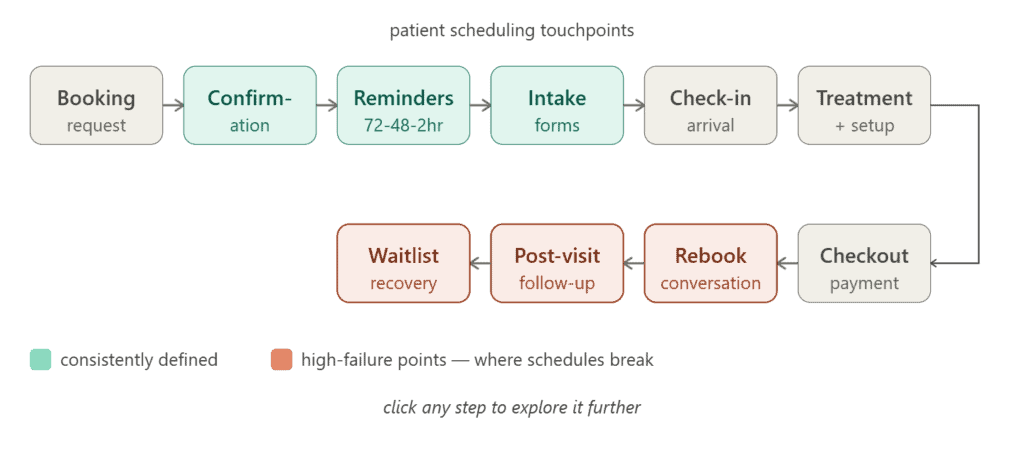
Start by listing every step in your patient journey, from booking to follow-up. Many owners find there are steps they never clearly set up or that different staff handle in different ways. A typical workflow includes booking, confirmation, reminders, intake forms, check-in, treatment, checkout, payment, rebooking, and follow-up. That’s around ten steps, and in many med spas, several of them aren’t done consistently.
This is where schedules start to break. If rebooking is missed at checkout, patients may not return for months. Whereas if intake forms aren’t ready before arrival, check-in slows and delays the entire day. These aren’t individual mistakes, but gaps in the process. Mapping each step helps you see and fix where things are going wrong.
Pull Three Numbers
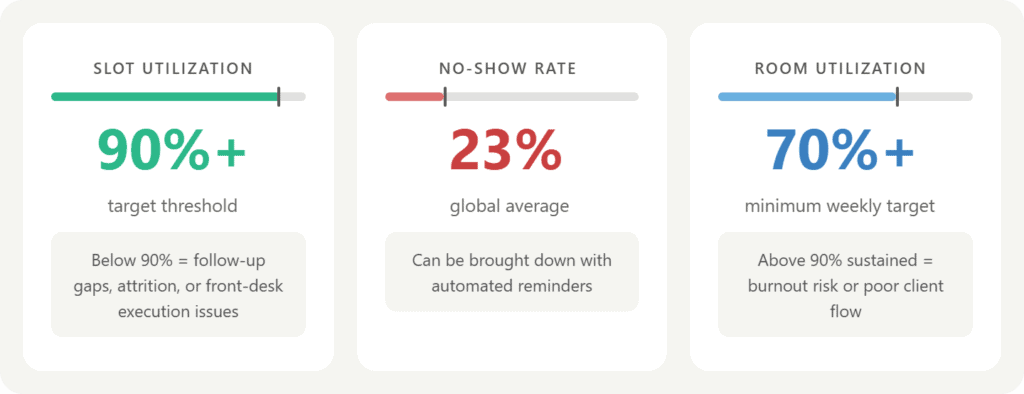
After mapping your workflow, track three important numbers for each treatment, not just for the whole practice, as overall averages can hide real problems. Focus on no-show rate, slot fill rate, and how often treatments run over time. If scheduling efficiency drops below 90%, it usually points to issues in follow-ups, patient drop-off, or front desk execution. Room usage should stay around 70% or higher and be reviewed weekly to catch gaps early.
When you look at each service separately, patterns become clear. For example, Botox may have more no-shows than laser treatments, or one service may regularly run late and delay the rest of the day. Without this detail, inefficiencies stay hidden, and revenue slowly declines, even when the schedule looks full.
Find Your Friction Services
Every med spa has treatments that seem simple on the schedule, but end up disrupting the whole day. These are called friction services. They’re appointments that need extra setup, take longer than planned, or require steps like numbing or room preparation that aren’t shown in the calendar.
Examples of friction services include laser treatments that need 30–45 minutes of numbing and combined procedures booked in one slot but needing more time. Consultations that turn into same-day treatments without buffers are also an example.
These problems don’t just affect one patient. When a service runs over time, it often reveals deeper workflow issues like poor preparation or missing information. Even one early delay can remove the buffer for the rest of the day and disrupt the entire schedule.
The Red-Flag Checklist
Before making changes, look for five warning signs that your schedule may already be losing money:
- Providers start running behind by mid-morning, even on smooth days.
- No-shows are only noticed at the time of the appointment instead of being prevented earlier.
- Rebooking at checkout is rushed or missed.
- There’s no clear data on which services run over time, which slots fill slowly, or which providers have higher no-show rates.
- The front desk manages cancellations and rescheduling reactively, without a clear process.
If three or more apply, the problem is deeper than simple fixes. If all five are true, the main issue isn’t reminders or follow-ups, but visibility. When scheduling, charting, and communication are spread across different systems, it’s hard to see the full picture. A single, unified view of your schedule is what makes real improvement possible. This can be achieved with PatientNow, a unified system built specifically for aesthetic practices, bringing scheduling, EMR, communication, and reporting into one place. So, everything functions together naturally, from consultation to checkout.
The platform’s KPI dashboards and employee performance tracking automatically surface important metrics like no-show rates, slot utilization, and provider performance. Thus, instead of piecing together information from multiple tools, you get a clear, complete view of your schedule. This makes it easier to identify problems early and improve with confidence.
How to Improve Patient Scheduling Workflow At Your Medical Spa
A strong scheduling workflow doesn’t happen by chance. It’s built with small, intentional improvements. Once you understand where your gaps are, the next step is to refine how your schedule actually operates day to day. Here’s how to bring structure, clarity, and consistency into your scheduling process:
Build Treatment-Specific Appointment Blocks
One of the biggest scheduling mistakes in med spas is using the same time slot for every treatment. A quick Botox visit shouldn’t be scheduled like a longer laser procedure. Each service needs its own time block based on the full process, like treatment time, setup, numbing, checkout, and room reset.
A good first step is to create a treatment matrix that lists every service and how long it truly takes. This helps you build realistic schedules instead of using one fixed slot size. You can also improve flow by mixing short and long treatments across the day so provider time isn’t wasted. Combination treatments should be planned as extended or linked appointments, not squeezed into a single short slot.
When done right, this turns an average day into a fully booked, efficient schedule without adding more patients. PatientNow supports this with built-in buffer timing, multi-service booking, and drag-and-drop scheduling to easily adjust the day.
Stop Relying on a Single Reminder
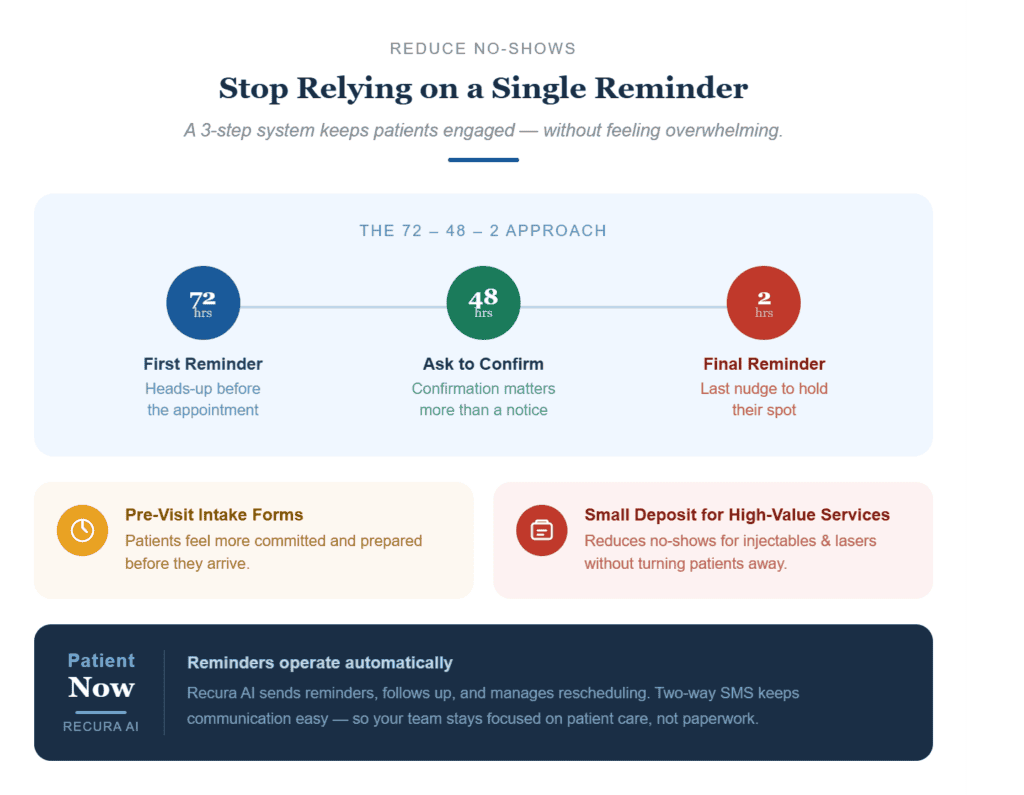
One reminder isn’t enough to reduce no-shows. A simple three-step system functions better and keeps patients engaged without feeling overwhelming. So, employ a 72-48-2 approach:
- Send a reminder 72 hours before.
- Send a follow-up at 48 hours, asking the patient to confirm.
- Send a final reminder 2 hours before the appointment.
Always ask for action, as confirmation matters more than just sending a notice. Pre-visit intake forms also help patients feel more committed and prepared. For higher-value services, a small deposit can help reduce no-shows without turning patients away. Keep your message clear and polite, like asking them to confirm to hold their spot.
With PatientNow, reminders operate automatically. Its integrated Recura AI assistant sends reminders, follows up, and manages rescheduling, while two-way SMS keeps communication easy. So, your team doesn’t have to manage it manually, and there’s less paperwork and more presence with your patients.
Turn Your Waitlist Into a Same-Day Revenue Recovery Tool
Most med spa waitlists are unstructured and underused. But a well-run waitlist should quickly fill open slots, often the same day, without adding extra work for your team. Thus, organize your waitlist by service and provider, not as one general list, so the right patient fills the right opening.
When a spot opens, send a quick message with a clear response window. Fast replies will help you recover revenue. You can also prioritize loyal clients, members, or higher-value bookings. Manage same-day cancellations differently from those further out. Same-day gaps also need patients ready to book immediately, while future slots allow more time to fill.
With PatientNow, this runs automatically. Waitlist alerts are sent instantly, and memberships or loyalty status can discern priority, helping you fill cancellations faster and keep your schedule balanced.
Train Your Front Desk to Schedule Strategically, Not Just Reactively
Software can support your schedule, but your front desk makes it work. So, the focus should shift from reacting to bookings to managing them with purpose. Start by filling harder time slots first, like mid-morning or early afternoon, then build around them. Rebooking at checkout should always happen, as it’s the best time to secure the next visit.
In addition, keep guidance simple with short scripts and clear standards, and allow room for judgment when handling walk-ins or changes. A one-page guideline, reviewed often, keeps everyone aligned. Moreover, when patients book correctly online, your team spends less time on admin and more time on patient care. With PatientNow, online booking, mobile access, and automated follow-ups support this shift, so your team focuses on patients, not paperwork.
Three Numbers That Tell You the Fix Is Working
A better schedule should show results within 30 days for a medspa. You only need to focus on three important numbers to see what’s improving, like slot utilization, no-show and late-cancel rates, and time-to-fill after a cancellation. When these improve, your schedule becomes steadier and more profitable, a clear advantage many practices miss.
With PatientNow, these metrics are tracked automatically through built-in dashboards and recall tools. In fact, practices using these features have increased return visits from 40% to 70%. The system offers smart automation to manage the routine and tracking, so your team can focus on patients.
Ready to bring more structure and growth to your schedule? Book a demo with PatientNow!