
Whether you’re building a before and after portfolio to showcase beautiful outcomes or using photography for teaching and education, your office needs to take photos of patients on a daily basis. Great photos boost sales, so you want your pictures to look clean and consistent. In fact, 74.8% of aesthetic patients wouldn't even consider choosing a practitioner who doesn't have high-quality photos to browse.
While photography plays a key role in your practice as a medical professional, how much should you spend on medical photography equipment? As very few offices have a skilled photographer on staff, it can be tricky to decide on the best camera to use — especially without breaking the bank. Let's dive into the pros and cons of the three most common options for aesthetic photography.
1. DSLR Cameras
Many healthcare and aesthetic providers opt for a DSLR camera as their medical photography equipment. When using these cameras, most practitioners will set up a dedicated photography room to ensure their pictures always look the same, shot after shot. They often have to bring in a professional photographer to set their DSLR camera with the proper aperture for the room’s lighting, choose the correct lens, and set up a tripod to achieve the perfect angle and distance from the patient.
Here are all the pros of using a DSLR camera in your practice:
- They have many features to adjust lighting, movement, and distance from your patient, producing top-tier images.
- They're compatible with most standard tripods, giving you some freedom to move around.
- In “auto” mode, they can be used like point-and-shoot cameras, allowing you to take photos without professional help.
However, these cameras also have a few cons:
- Their “auto” mode is not always the ideal setting, so you may need to fiddle around to get the correct white balance, exposure, aperture, ISO, and f-stop, which can be complicated.
- Taking photos that wow your patients requires hiring a trained photographer or training one of your staff members to use the camera properly.
- As DSLR cameras need a dedicated photography station, you'll have the hassle of shuffling patients from room to room. They'll also need to wait their turn to take photos, which can waste your patients' and providers' time.
- You'll have to manually upload your pictures from the SD card to your computer for storage, making it tough to search for and quickly access the ones you need.
Thanks to their many features, DSLR cameras can be great for aesthetic photography — but only if your staff is trained to use them. Otherwise, you essentially spend way more than you need for a glorified point-and-shoot digital camera.
2. Medical Imaging Systems
A medical imaging system is a hardware product specifically designed for clinical photography. Some are made for snapping close-ups or for full-length body shots, while others are similar to DSLR cameras because they are handheld and can document any body part. Most medical or aesthetic providers also set up a photography room for these types of cameras.
Here are the pros of medical imaging systems:
- Because they were created with medical photography in mind, medical imaging systems allow you to consistently take top-notch photos.
- They're a complete system with built-in photo management software that makes it easier to catalog medical photos more accurately.
On the flip side, the cons of these machines are:
The size of these pieces of equipment can make it difficult to move them from one room to another. This usually means that your practice will need a dedicated photography room, limiting other potential uses for your office space.
You're looking at an upfront cost of $15,000 or more, which is unfeasible for many practices.
Medical imaging systems' hardware can become outdated in a few years, allowing the manufacturer to upsell you the newest version. While this boosts their bottom line, it will have the opposite effect on your practice and drain your profits.
Your team will need a high level of training to master the software and hardware and get those high-quality images.
3. Mobile Devices
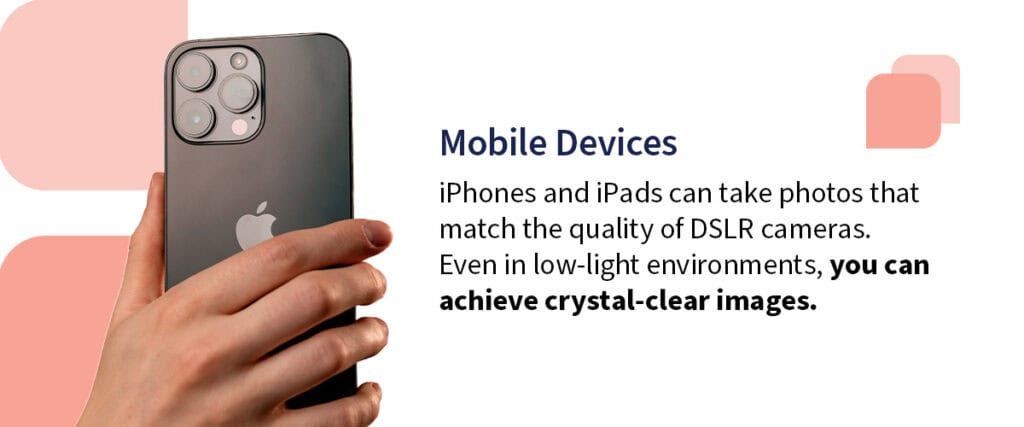
Given how pricey DSLR cameras and medical imaging hardware can be, it's easy to see why more doctors are using mobile devices such as tablets and smartphones. As mobile cameras have been improving at a staggering pace, you don't have to sacrifice stunning images in your quest for cost-effective medical photography.
Nowadays, iPhones and iPads can take photos that match the quality of DSLR cameras. Even in low-light environments, you can achieve crystal-clear images for a fraction of the price. Here are all the pros of mobile devices:
- They're easy to move around, and you can bring a tablet or smartphone into any exam room.
- You can use various devices, whether an iPhone, iPad, Android phone, or Android tablet.
- Because you and your team already use these devices daily, they don't require extensive training.
- Most of these devices have excellent camera specs without useless features. For instance, the iPhone 16 boasts dual lenses with 26 and 52mm focal lengths, an f/1.6 aperture, optical image stabilization, and a True Tone flash — more than enough to create quality patient photos.
Of course, there are some cons, too:
- They're not HIPAA compliant.
- They have limited sensor and lens sizes.
Mobile Devices Versus DSLR Cameras and Medical Imaging Systems
Let's take a closer look at how mobile devices compare to DSLR cameras and medical imaging systems.
Mobile Devices Versus DSLR Cameras
Smartphone and tablet cameras are often just as good — if not better — than standard point-and-shoot digital cameras. However, they don't have the features of a DSLR camera, such as swappable lenses, adjustable aperture for varying amounts of light, or larger sensors for larger printouts.
These features are overkill for your purposes, and a less expensive mobile device can do the job. If treated like a DSLR camera by using consistent lighting and setup, a smartphone or tablet can take images of the same caliber.
Mobile Devices Versus Medical Imaging Systems
As discussed, imaging hardware products are designed specifically for clinical photography. While these machines take excellent patient images, the image quality on a smartphone or tablet is good enough for most healthcare or aesthetic providers.
With mobile devices, you may be worried about consistency — taking photos with the same format, lighting, and angles can be a real challenge, but it is essential for building a library of quality before and after photos. Medical imaging systems have a clear edge in this regard, with image consistency being a feature that manufacturing companies stress.
How to Overcome the Drawbacks of Mobile Devices in Aesthetic Photography
Overcome the drawbacks of mobile devices with apps such as RxPhoto, which works on iOS smartphones and tablets to maximize their potential. Our platform incorporates all the most important features of expensive imaging system cameras, proving that mobile devices are just as efficient and more versatile than bulky clinical photography studios.
Here's how RxPhoto can help you get past the limitations of basic mobile device photography and even DSLR cameras and medical imaging systems:
- Take consistent images: On-screen templates and ghosting features allow “after” pictures to perfectly align with “before” pictures, helping your team capture standardized patient photos.
- Keep your photos safe and secure: RxPhoto automatically stores your photos on a HIPAA-compliant cloud server instead of the device that takes the image, protecting your patients' privacy. You can access this server from any office computer.
- Find the images you need: RxPhoto also sorts and organizes your photos by patient, date, and body part, helping you quickly and effortlessly find the images you're looking for.
- Save time and money: Your staff can bring their devices, eliminating the need for big equipment purchases. Your team will also only need some light training, allowing them to start snapping away as soon as possible.
- Share to your social media: You've done outstanding work and have high-quality images as proof. With RxPhoto's one-touch push to social, you can connect with your followers more regularly and increase referrals by elevating your practice's online reputation.
Mobile device cameras are continually improving, and RxPhoto will evolve alongside them. As these technologies advance even further, you will find more and more practitioners using them for their ease of use, portability, and financial benefit — taking costs down from thousands of dollars to just hundreds.
Beyond making medical photography equipment more cost-effective, RxPhoto can make your practice more profitable. High-quality photos turn consultations into patients, and beautiful before and after shots might convince someone to proceed with a treatment worth a pretty penny.

Maximize the Potential of Mobile Devices With PatientNow
PatientNow provides a cost-effective and efficient solution for medical photography. With RxPhoto, you can take clean and consistent patient images straight from your mobile device while ensuring you're HIPAA-compliant. Schedule a demo to discover how our platform's features can produce picture-perfect results every time!
Explore this post
Book a demo to see PatientNow in action