
Table of Contents
Quick Summary
Choosing the right EMR can make or break how smoothly your med spa practice runs. Choosing the right EMR can make or break how smoothly your small aesthetic practice runs. The right software simplifies clinical workflows, automates marketing, and unifies scheduling, payments, and patient management, helping your practice grow efficiently without juggling multiple tools.
EMR Software: A Critical Component of Small Aesthetic Practices
Running a small aesthetic practice means juggling clinical care, operations, and marketing. But you don’t have to patch together four different tools just to chart, book, and follow up with a patient.
A purpose-built EMR does all that and more. This guide breaks down the 10 best EMR options for small aesthetic practices, with honest assessments of what each one does well and where it falls short.
Why Listen to Us?

PatientNow has served aesthetic practices exclusively since 2004. We have over two decades of experience building software for med spas, plastic surgery clinics, and wellness centers. That’s why we understand the real challenges small aesthetic practices face, from compliance and charting to marketing and profitability. Our focused industry expertise, real customer results, and deep knowledge of competing platforms make us uniquely qualified to evaluate the best EMRs for small aesthetic practices.
What Is EMR Software and Its Benefits For Your Practice?
An Electronic Medical Record (EMR) system is software that manages clinical documentation, patient records, and practice workflows in a digital environment. For aesthetic practices, a strong EMR goes further.
It also supports injection tracking, before-and-after photo documentation, HIPAA-compliant charting, and in many cases, marketing automation, scheduling, and billing.
Among other things, the right EMR software will:
- reduces administrative burden.
- supports compliance.
- enables easier scheduling.
- streamline clinical documentation.
- creates delightful patient experiences.
For small practices especially, choosing a platform that handles multiple functions in one place can eliminate the cost and friction of juggling separate tools.
Quick Comparison: 10 Best EMRs for Small Medspa Practices
Here is a quick side-by-side look at all 10 tools covered in this guide:
| # | Tool | Key Features | Good For |
| 1 | PatientNow | AI automation, full marketing suite, clinical EMR | Med spas & aesthetic practices |
| 2 | Calysta EMR | Charting templates, consent forms, patient portal | Small aesthetic clinics |
| 3 | Zenoti | AI scheduling, multi-location, CRM | Enterprise med spa chains |
| 4 | Aesthetic Record | AI Scribe charting, photo management, inventory tracking | Budget-conscious startups |
| 5 | Pabau | Online booking, automated marketing, EMR | Small to mid-size UK/EU practices |
| 6 | Symplast | Mobile-first EMR, surgical workflows, photo management | Plastic surgery practices |
| 7 | OptiMantra | Telehealth, e-prescribing, charting | Integrative wellness clinics |
| 8 | Nextech | Enterprise reporting, AI Scribe, photo management | Larger plastic surgery practices |
| 9 | ModMed | Specialty EHR, practice analytics, telehealth | Dermatology practices |
| 10 | Jane App | Online booking, AI Scribe, client portal | Small multi-disciplinary clinics |
Let’s unpack what each tool offers.
1. PatientNow
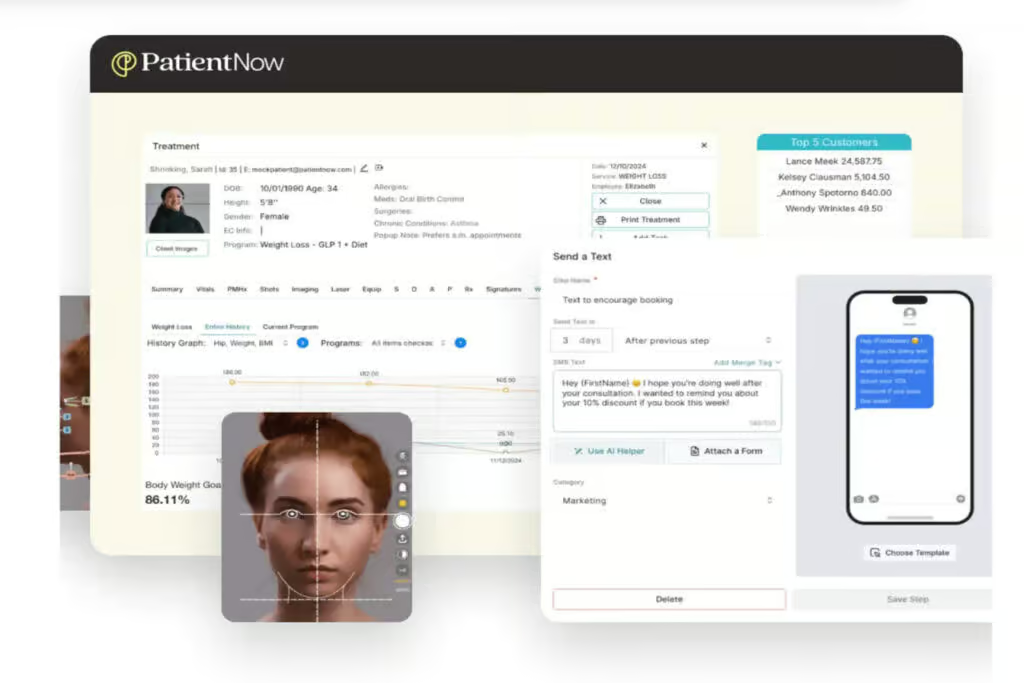
PatientNow is a clinical-grade, all-in-one platform built exclusively for aesthetic, dermatology, and wellness practices. It offers a unified system that connects EMR, marketing, patient engagement, advanced photography, and practice management.
It is designed for practices that want to grow without the friction of disconnected tools. What sets PatientNow apart is that it combines both clinical depth and efficient marketing, helping providers deliver better care while maximizing revenue and retention.
Key Features
- AI Automation: Recura fills your schedule without draining manual follow-up effort.
- Built-in Marketing Suite: Replaces the need for a separate agency or several scattered tools, saving you money and time.
- Clinical-grade EMR: Supports injection tracking, e-prescribing, and telehealth, enhancing practice efficiency.
- Inventory Management: Provides real-time tracking and automated reordering so you know exactly what you have and when it’s time to order more.
- KPI Dashboards and Employee Goal Tracking: Gives you full business visibility of your practice, keeping everything and everyone aligned to your care goals.
Integrations
PatientNow integrates with QuickBooks, Canva, 120+ lab vendors, CareCredit, Tippy, and its built-in AI booking agent, Recura. These integrations unify accounting, marketing, labs, payments, and automated lead conversion in one ecosystem.
Pros
- Purpose-built for aesthetics.
- True all-in-one platform, with no need for separate tools.
- AI automation handles lead follow-up and booking automatically.
- HIPAA-compliant charting.
- Surgical and non-surgical workflows.
- Transparent per-location pricing with predictable costs.
Cons
- Higher starting price, but delivers ROI through increased retention, higher revenue per visit, and fewer third-party tools.
Good For
Med spas, aesthetic clinics, weight loss centers, and wellness practices that want a complete, clinical-grade platform without patching together multiple vendors.
2. Calysta EMR
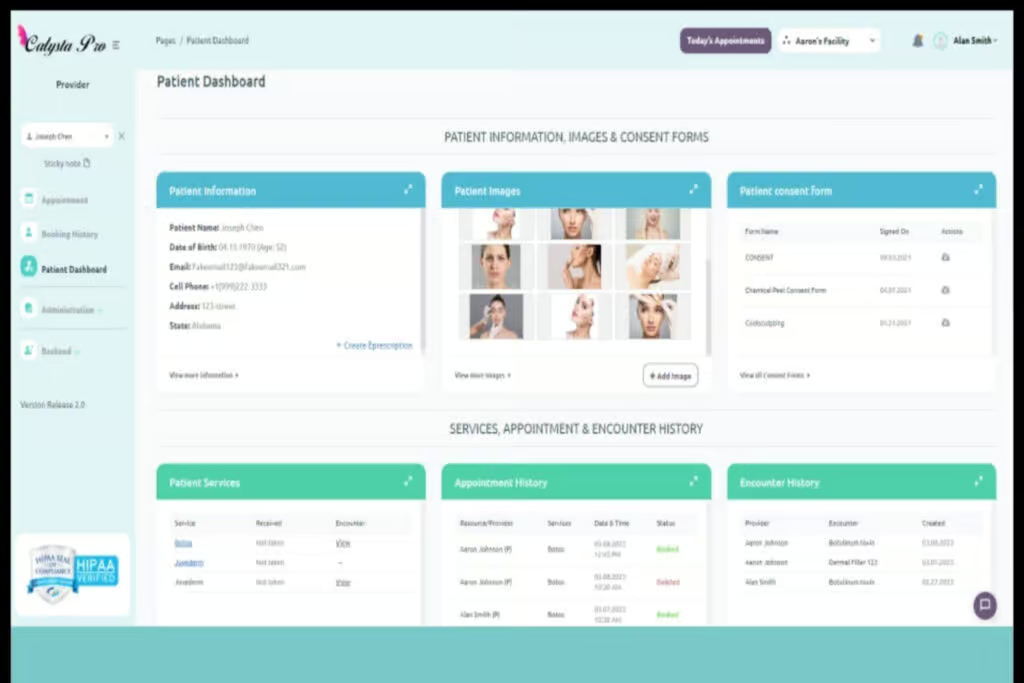
Calysta EMR is a platform built specifically for medical aesthetic practices. It focuses on the clinical side of practice management, offering customizable charting templates, digital consent forms, and a clean patient portal.
Key Features
- Customizable Charting Templates: Allow users to create, edit, and tailor documentation to specific services.
- Digital Consent Forms: Enables aesthetic patients to sign documents remotely or in-office via any device with e-signature support for streamlined intake.
- Patient Portal: Provides efficient appointment management and records access for convenient self-management.
Integrations
Calysta EMR connects with standard payment processors and supports online booking through its patient portal, offering basic but sufficient integrations for smaller clinics.
Pros
- Clean, intuitive interface.
- Aesthetic-specific charting templates.
- Easy consent and intake process.
- Good fit for smaller teams.
Cons
- Limited built-in marketing tools.
- Fewer integrations than larger platforms.
- Less suited to multi-location practices.
Good For
Small aesthetic clinics and solo providers looking for a focused, clinical documentation tool without the overhead of a full practice management suite.
3. Zenoti
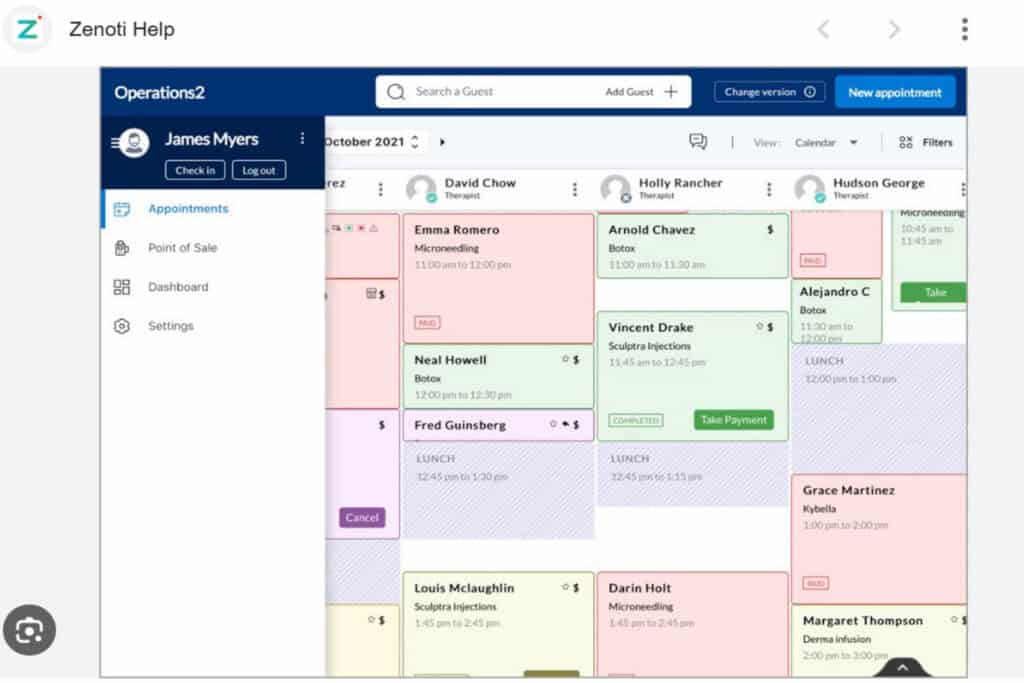
Zenoti is a comprehensive platform originally built for salons and spas that has expanded into the med spa market. It is best known for its enterprise capabilities and is widely used by larger spa chains and franchise groups.
Key Features
- AI Scheduling Tools: Suggest optimal booking times automatically and support voice-based bookings.
- Multi-location Management: Enables you to manage inventory centrally, complete with brand-level permissions and reporting.
- CRM and Marketing Automation: Puts guests into specific, similar-interest groups for personalized follow-up and higher patient engagement and retention.
Integrations
Zenoti supports integrations with Shopify, QuickBooks, Zoom, CareCredit, and Zapier, giving practices a broad ecosystem for connecting handy third-party tools.
Pros
- Strong enterprise and multi-location capabilities.
- Real-time analytics dashboards.
- Broad integration ecosystem.
- AI-first product roadmap.
Cons
- Complex onboarding that can take months.
- Over-engineered for small practices.
- Offshore support with limited post-launch hours.
Good For
Enterprise med spa chains and franchise operations that need centralized brand control.
4. Aesthetic Record
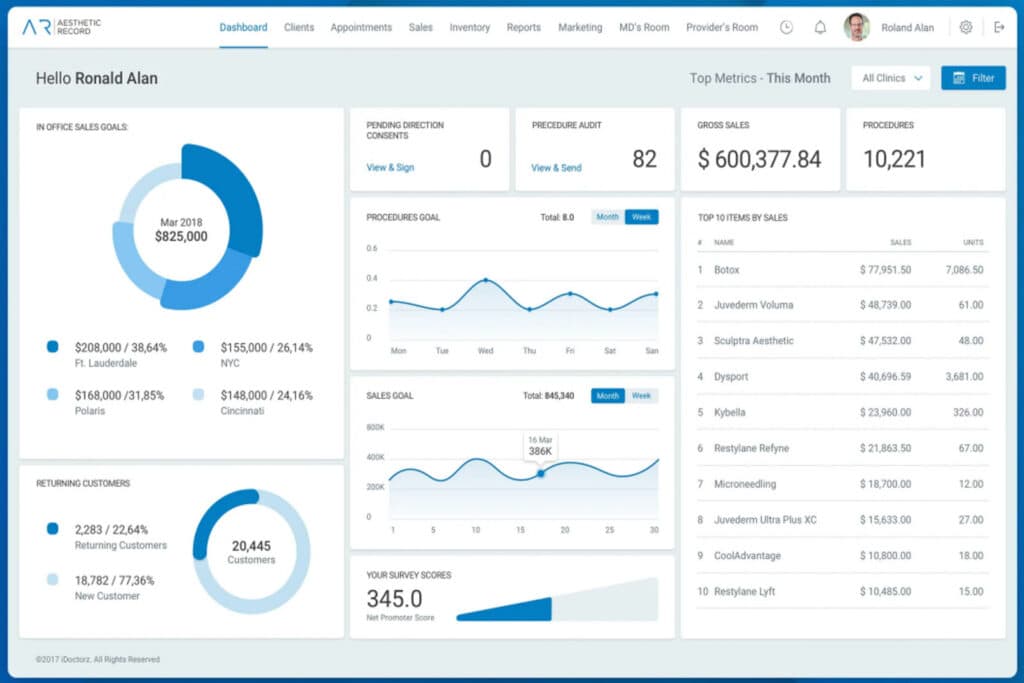
Aesthetic Record is a specialized EMR solution designed to streamline aesthetic practice operations. The platform has built a following among cost-conscious startups and smaller practices with an accessible per-user pricing model and a growing AI charting toolset.
Key Features
- AI Scribe: Converts voice notes directly into charting entries and generates detailed patient summaries, reducing the need for manual typing.
- Photo Management: Allows patients to take before-and-after photos from their phones, so there’s no need for manual file transfer.
- Inventory Tracking: Track stock in real-time from intake to discharge and checkout.
Integrations
Aesthetic Record uses a white-labeled CRM built on HighLevel for lead and pipeline management. It connects with Stripe for payment processing and supports standard intake and consent form workflows.
Pros
- Low entry price per user.
- AI charting tools are included.
- Purpose-built for aesthetics.
- Group buying discounts on devices.
Cons
- Known for glitches and platform instability.
- Hidden add-on costs.
- Reporting lacks customization depth.
Good For
Budget-conscious practices and new med spas looking for an affordable starting point with aesthetic-specific charting.
5. Pabau
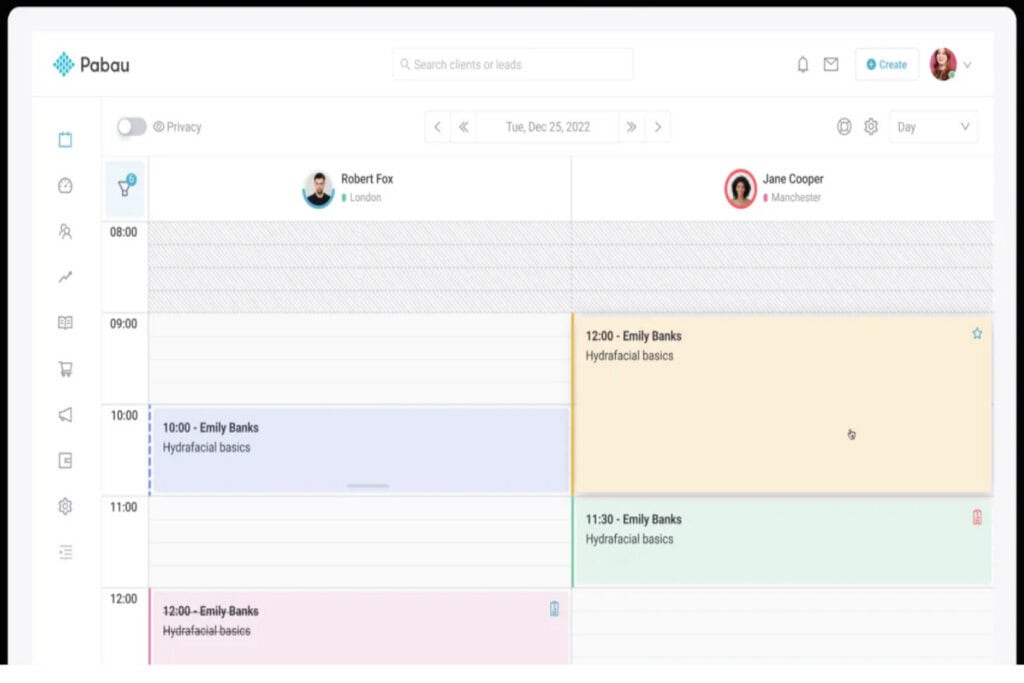
Pabau is a respected practice management platform popular among aesthetic and wellness clinics, particularly in the United Kingdom and Europe. The platform simplifies day-to-day operations for growing practices.
Key Features
- Online Booking: Allows patients to self-book and get automated reminders and follow-ups.
- Automated Marketing: Supports typical aesthetics workflows, including email and SMS campaigns.
- Customizable EMR Templates: Tailor aesthetic treatments and consultations to individual patient needs.
Integrations
Pabau connects with Xero for accounting, Stripe for payments, Mailchimp for advanced email campaigns, and various online booking channels.
Pros
- Straightforward setup process.
- Good automated communication tools.
- Clean, modern interface.
- Solid option for UK-based practices.
Cons
- Limited U.S. market presence and support.
- Less clinical depth than U.S.-focused platforms.
- Fewer integrations for U.S.-based vendors.
Good For
Small to mid-size aesthetic and wellness clinics, particularly those operating in the UK or EU.
6. Symplast
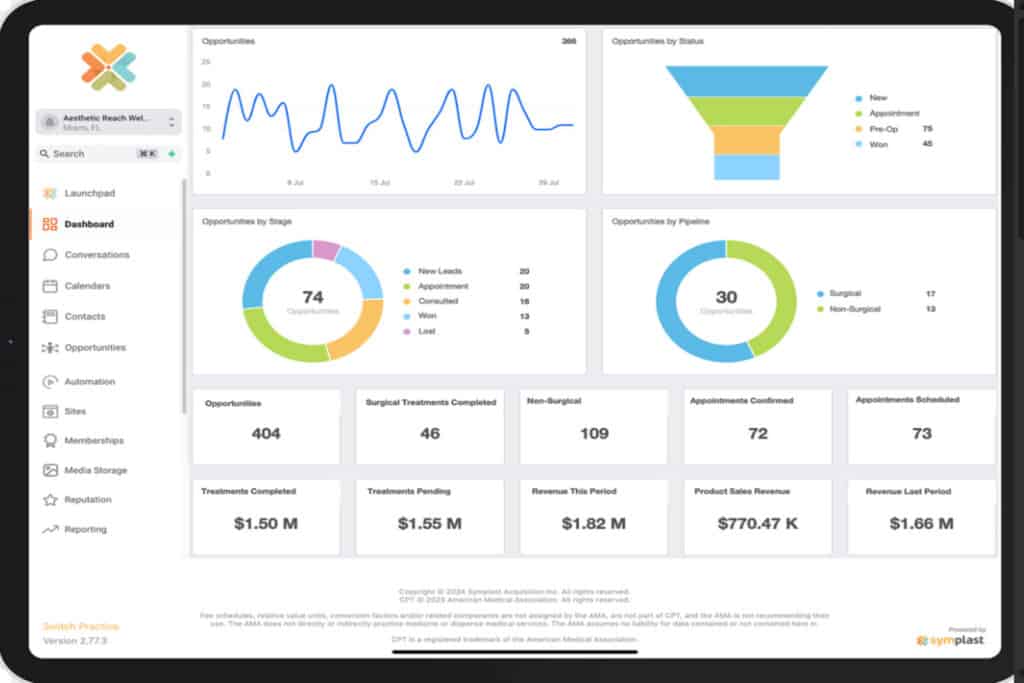
Symplast is a mobile-first EMR and practice management platform for plastic surgery practices. It emphasizes surgical workflow support, patient engagement, and clinical documentation with a strong focus on photo management and before-and-after galleries.
Key Features
- Mobile-first EMR: Enables on-the-go provider documentation so patients can access data from anywhere.
- Surgical Workflow Tools: Supports consult-to-surgery case management, including room allocation and wait time monitoring for smooth intake.
- Photo Management: Provides access to patient-facing galleries and social sharing for secure sharing of photos and videos between patients and providers.
Integrations
Symplast integrates with standard payment processors and supports digital forms, patient messaging, and external billing workflows. Its mobile app is a core differentiator, enabling providers to chart and communicate from anywhere.
Pros
- Strong mobile-first design.
- Purpose-built for plastic surgery.
- Good patient engagement tools.
- Solid before-and-after photo management.
Cons
- Narrower fit outside plastic surgery.
- Limited built-in marketing automation.
- Pricing not publicly available.
Good For
Plastic surgery practices where before-and-after documentation is central to the workflow.
7. OptiMantra
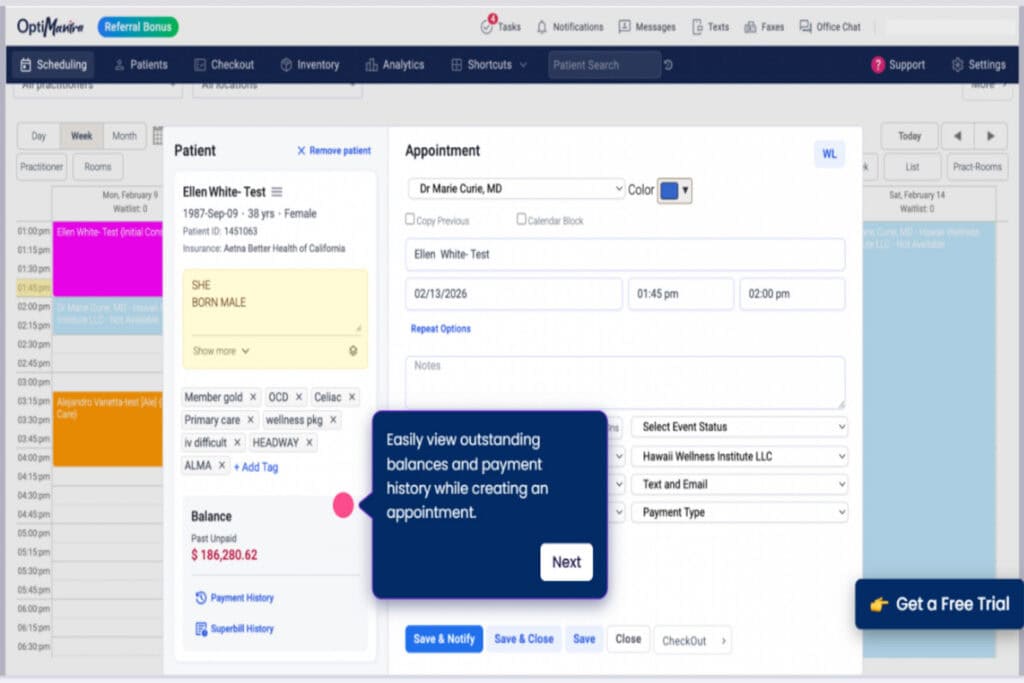
OptiMantra is a practice management and EMR platform for integrative and wellness-focused clinics. It supports telehealth, e-prescribing, clinical charting, and scheduling within a single system designed for multidisciplinary practices.
Key Features
- Telehealth Tools: Enable virtual consultations and follow-ups, providing convenience for both providers and patients.
- E-prescribing: Securely prescribe controlled substances faster with required regulatory compliance.
- Customizable Charting Templates: Cater to diverse wellness and aesthetic services.
Integrations
OptiMantra connects with popular lab vendors, payment processors, and telehealth infrastructure. Its integration set is aligned to the needs of integrative practices rather than high-volume aesthetic clinics.
Pros
- Supports diverse wellness disciplines.
- Built-in telehealth and e-prescribing.
- Flexible charting options.
- Good for multidisciplinary teams.
Cons
- Not specifically designed for aesthetics.
- Limited marketing tools.
- Less suited to high-volume med spas.
Good For
Integrative medicine and wellness clinics that offer a blend of functional medicine, naturopathy, and aesthetic services.
8. Nextech
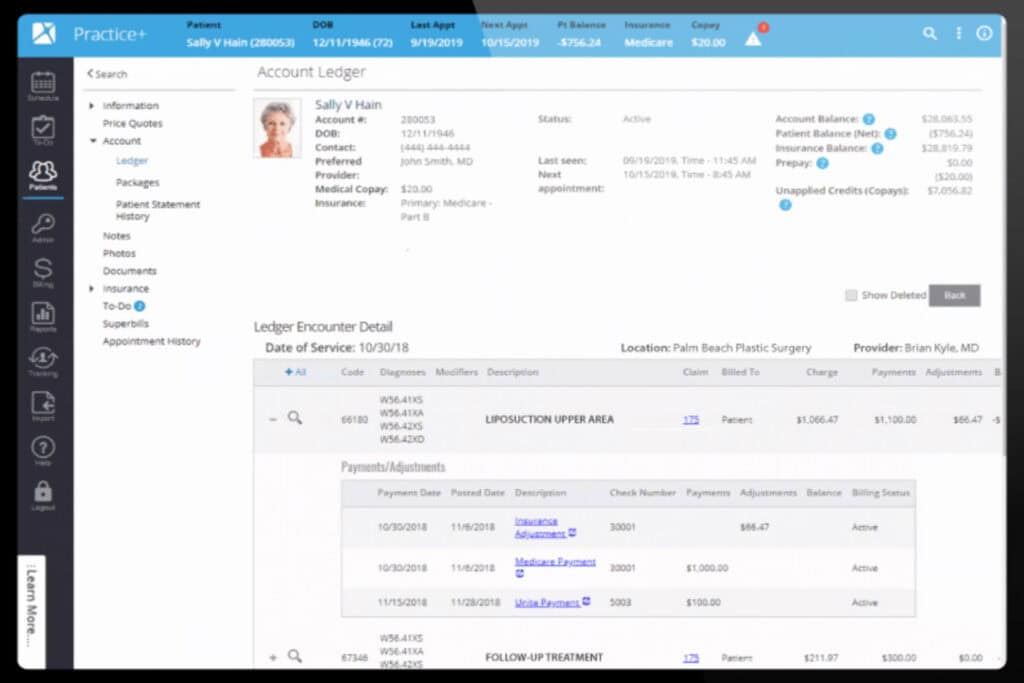
Nextech is an enterprise-grade EHR and practice management platform with a broad specialty footprint across ophthalmology, plastic surgery, and dermatology. It’s good for deep clinical workflows, multi-location management, and a growing AI toolset.
Key Features
- Enterprise Reporting: Facilitates rapid patient data analysis for larger practices to monitor practice profitability and efficiency.
- AI Scribe: Captures clinical conversations and populates chart notes to ease the administrative burden.
- Advanced Photo Management: Capture sharp, consistent patient photos and add markups, annotations, and layered drawings.
Integrations
Nextech offers a white-labeled CRM, a broad integration marketplace, and support for major lab vendors, telehealth tools, and billing partners. Its integration depth reflects its enterprise target market.
Pros
- Deep clinical EHR capabilities.
- Strong enterprise and multi-location tools.
- Growing AI feature set.
- Broad specialty experience.
Cons
- High cost, especially for small practices.
- Not built natively for aesthetics.
- Limited practice management and membership tools.
Good For
Larger plastic surgery practices that need enterprise-grade EHR functionality.
9. ModMed (Modernizing Medicine)
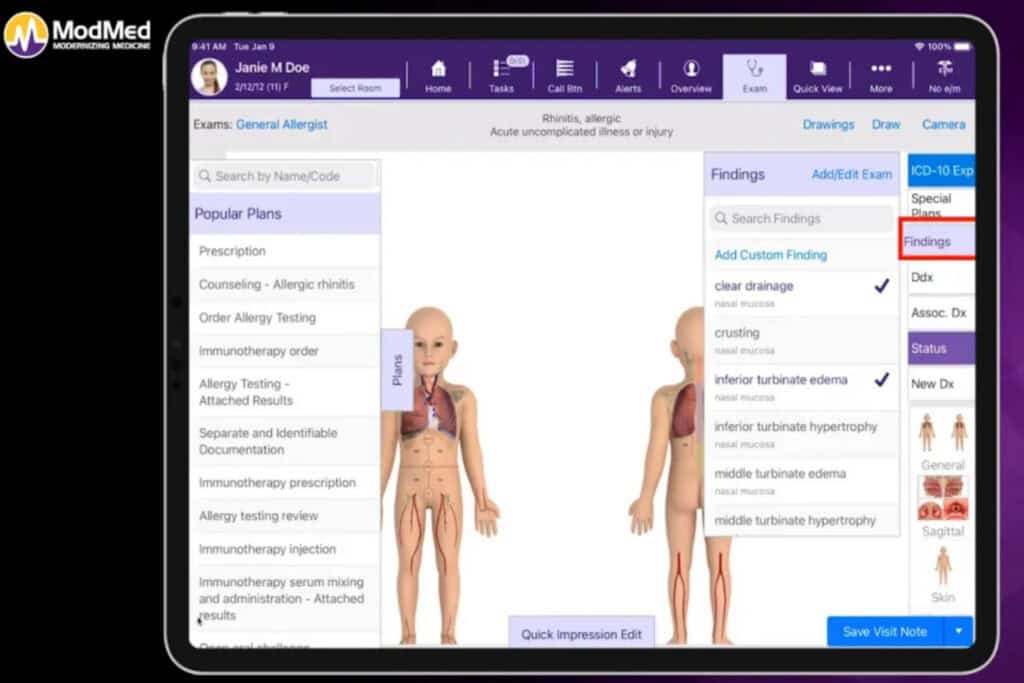
ModMed is a specialty-specific EHR platform with a strong presence in dermatology. Its dermatology suite includes AI-assisted documentation, practice analytics, integrated revenue cycle management, and telehealth capabilities.
Key Features
- Specialty EHR: Dermatology-specific charting templates and workflows improve efficiency.
- Practice Analytics Tools: Revenue forecasting and clinical reporting enable easier long-term planning.
- Telehealth: Deliver your care services virtually, complete with integrated patient documentation.
Integrations
ModMed connects with major lab networks, insurance clearinghouses, patient engagement platforms, and billing tools. Its revenue cycle management integrations are particularly strong for practices managing insurance billing alongside cash-pay aesthetic services.
Pros
- Deep dermatology-specific clinical tools.
- Strong revenue cycle management.
- AI-assisted charting reduces documentation time.
- Solid telehealth infrastructure.
Cons
- Not designed for med spas or aesthetic-only practices.
- Limited marketing and patient retention tools.
- Enterprise pricing may not suit small practices.
Good For
Dermatology practices that handle a mix of medical and cosmetic services.
10. Jane App
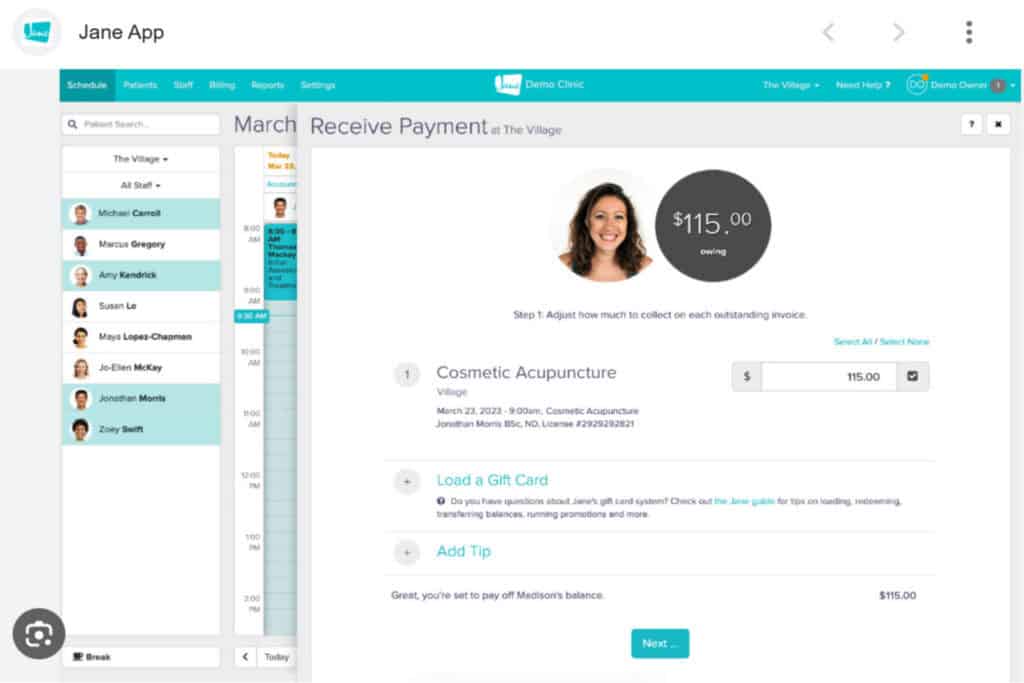
Jane App is a cloud-based practice management platform popular with small health and wellness clinics. It is known for its clean interface, ease of setup, and strong customer support.
Key Features
- Online Booking: Scheduling with automated appointment reminders reduces admin work for practitioners.
- AI Scribe: Converts practitioner notes into structured, easy-to-understand SOAP documentation.
- Client Portal: Lets patients manage their appointments, fill forms, and pay easily.
Integrations
Jane App connects with Mailchimp for email marketing, Stripe and Square for payments, Google Calendar for scheduling sync, and telehealth tools for virtual appointments.
Pros
- Highly rated for ease of use.
- Responsive customer support.
- Clean, modern interface.
- Good entry-level pricing.
Cons
- No native lead capture or nurturing.
- Limited aesthetic-specific clinical tools.
- No labs, e-prescribing, or inventory management.
Good For
Small multidisciplinary clinics and wellness practices that need a clean scheduling and booking system with basic EMR capabilities.
How to Choose the Best EMR for Your Small Aesthetic Practice
With so many options available, it helps to narrow the decision around what matters most to your practice. Here are five key criteria to guide your evaluation.
1. Clinical Depth
If your practice performs injectables, offers weight loss protocols, or plans to add telehealth or e-prescribing, confirm the platform supports those workflows natively. Whereas retrofitted tools or third-party add-ons create friction over time.
2. All-In-One Vs. Best-Of-Breed
Decide upfront whether you want a unified platform or a curated stack of specialized tools. A true all-in-one system reduces vendor management and often lowers total cost. A best-of-breed approach offers flexibility but requires more integration work.
3. Marketing and Patient Retention Tools
Patient acquisition and retention are central to a thriving aesthetic practice. Look for platforms with built-in lead capture, automated follow-up, reputation management, and loyalty or membership features. Practices that rely on outside agencies for these functions are often paying for capabilities that could be consolidated.
4. Scalability
Choose a platform you will not outgrow in 12 to 18 months, as switching EMR systems is disruptive, expensive, and time-consuming. So, evaluate whether the platform can support multi-location expansion, growing team size, and evolving service lines.
5. Support Quality
Implementation is only the beginning. Ongoing support for staff training, troubleshooting, and workflow optimization has a direct impact on how well the software performs day-to-day. U.S.-based support with aesthetic industry expertise is a meaningful differentiator.
Pick EMR Software For Your Small Aesthetic Practice With Care
There is no shortage of EMR options for small aesthetic practices. Most tools on this list do one or two things well. But PatientNow is different. It’s built exclusively for aesthetics, combining clinical-grade charting, automated marketing, scheduling, payments, and photo management in a single platform.
From the first online inquiry to checkout, follow-up, and long-term retention, PatientNow supports the entire patient journey. It scales as your practice grows, replacing multiple tools with one purpose-built system. For small aesthetic practices seeking the best EMR, PatientNow delivers efficiency, compliance, and growth.
If you are ready to see what a purpose-built aesthetic solution looks like in practice, PatientNow is what you are looking for. Book a demo today and see how it brings every part of your practice into balance.
Frequently Asked Questions About EMR for Small Aesthetic Practices
Let’s answer a few questions you may still have.
1. What is the best EMR for a small med spa just getting started?
For new med spas, the best EMR depends on your budget and clinical needs. Platforms like AestheticsPro and Aesthetic Record offer lower entry costs. However, practices that want to grow without switching platforms later often find that investing in a purpose-built solution like PatientNow. It delivers better long-term value, given its all-in-one design and scalability.
2. Do I need a separate marketing tool if I use an EMR?
That depends on the platform. Many EMRs focus purely on clinical documentation and require a separate CRM or marketing tool. But PatientNow includes a full built-in marketing suite with lead capture, automated campaigns, reputation management, and social posting, which eliminates the need for a separate agency or tool.
3. Is an EMR required for HIPAA compliance in aesthetic practices?
Yes. Any platform handling protected health information must support HIPAA-compliant data storage, access controls, and audit logging. Not all platforms marketed to aesthetic practices are fully HIPAA compliant, especially those built for salons or fitness studios. So, always verify compliance before selecting a platform.
4. What is the difference between an EMR and a practice management system?
An EMR focuses on clinical documentation. It includes aspects such as charting, notes, prescriptions, and medical records. But a practice management system covers operational workflows like scheduling, billing, inventory, and patient communication. Modern platforms like PatientNow combine both into a single unified system designed for end-to-end practice management.
5. How long does it typically take to implement an EMR?
Implementation timelines vary significantly by platform. Some tools, such as Jane App, can go live within days. But more comprehensive platforms may take several weeks for data migration, staff training, and configuration. However, PatientNow is designed for fast onboarding, and its U.S.-based team supports practices through the full implementation process.